Verdantix Green Quadrant For Carbon Management Software Reveals How Leading Providers Are Defining A New Era
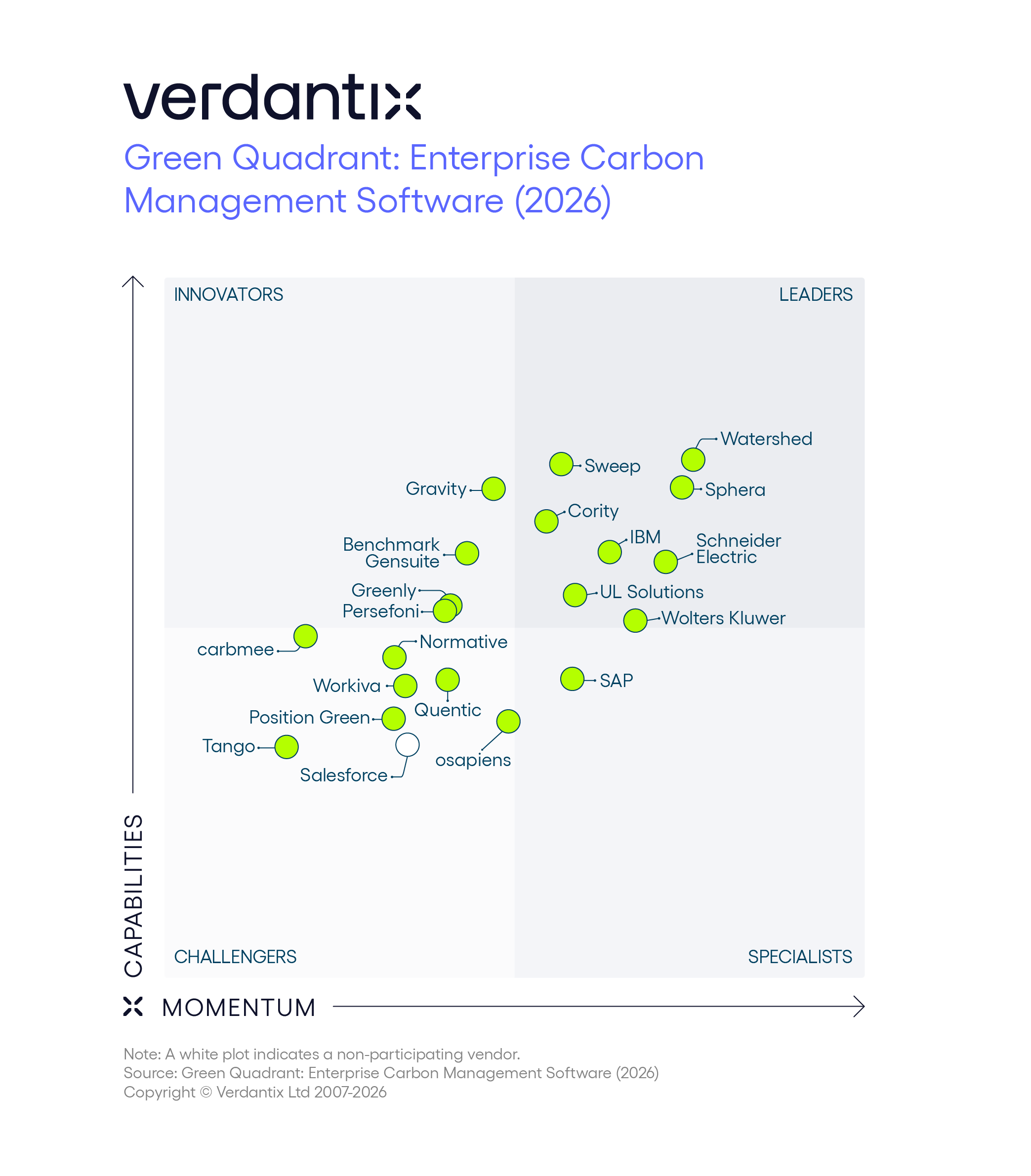
The recently released Verdantix Green Quadrant: Enterprise Carbon Management Software (2026) evaluates 21 prominent carbon management software providers, assessing their capabilities and momentum. Our analysis drew on a 91-point questionnaire, two-hour live demonstrations, 38 detailed buyer interviews and targeted desk research.
Key insights from the market:
- Core features are fast becoming table stakes.
As the market matures and consolidates, many features have become table stakes, making meaningful differentiation across vendors increasingly difficult. Capabilities such as manual data ingestion, emission calculations in line with the GHG Protocol, audit‑ready logging and supplier portals are now expected as standard.
- Operational decarbonization is rising in importance alongside compliance.
Organizations are moving beyond annual disclosures to embed decarbonization into day‑to‑day operations. Buyers now prioritize platforms that provide real‑time visibility at the asset, product and supplier level, enabling decision‑ready insights, rather than static reporting outputs. - Demand for granular, product-level emissions data is accelerating.
Customer pressure for product carbon footprints (PCFs) is reshaping supplier expectations across manufacturing and consumer sectors. Firms with complex product portfolios increasingly struggle to meet these demands manually, prompting growing adoption of automated PCF workflows. Product-level visibility is becoming central to procurement processes, supply chain transparency and competitive positioning. As a result, buyers are prioritizing solutions that offer scalable, auditable and standardized product-level emission management capabilities. - AI is emerging as a key source of market differentiation.
AI has shifted from a generic talking point to a defining capability in carbon management software, when applied selectively and backed by strong governance. Firms value AI that improves data quality, accelerates supplier engagement, identifies decarbonization initiatives, flags anomalies before audits, and automates time-intensive tasks such as emission factor matching. Vendors that deploy AI to resolve manual bottlenecks, rather than applying it indiscriminately, are differentiating most clearly in a crowded market.
To learn more, read the full report: Green Quadrant: Enterprise Carbon Management Software (2026) and join us for the webinar Carbon Management Software: What 'Good' Looks Like In 2026.
About The Author
.png?sfvrsn=db470322_1)
Alessandra Leggieri
Senior Analyst