Verdantix Green Quadrant Benchmark Reveals The New Rules Of Competition In APM
What’s new in APM? Not the ‘why?’ – the core drivers of improving profitability, reducing maintenance effort, increasing reliability and cutting emissions remain familiar. Rather, it’s the ‘how fast?’ that’s coming to the fore: labour shortages, supply chain realignment, energy volatility, geopolitical fragmentation and accelerating automation are all turning up the pressure in 2026.
The 2026 Verdantix APM solutions Green Quadrant report, our fourth edition, shows a market in motion. Vendors are racing to respond, with AI playing a central role. Those that can innovate quickly, and apply AI in practical ways, are pulling ahead, helping customers realize value faster – not through hype, but through measurable outcomes.
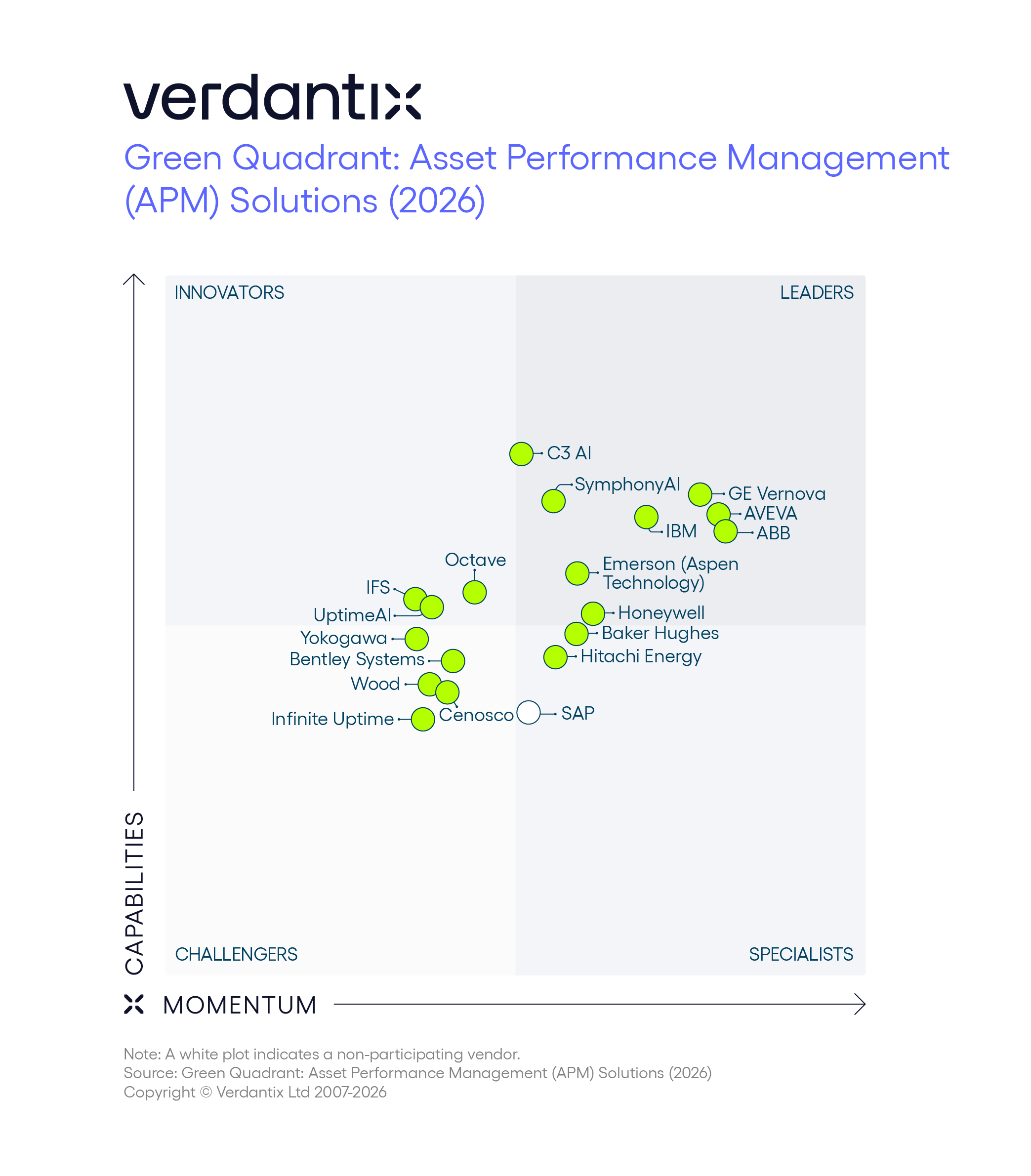
The Green Quadrant assesses 19 asset performance management (APM) software vendors on their products’ technical and functional capabilities and their market momentum. Our research entailed two-hour live software demos with participants, responses to a 128-point factual questionnaire, interviews with 28 corporate buyers of APM software, and desk research. The study also features findings from our latest industrial transformation global corporate survey of 333 operations, maintenance, engineering, IT and process safety decision-makers. The software vendors featured in this Green Quadrant are ABB, AVEVA, Baker Hughes, Bentley Systems, C3 AI, Cenosco, Emerson (Aspen Technology), GE Vernova, Hitachi Energy, Honeywell, IBM, IFS, Infinite Uptime, Octave, SAP, SymphonyAI, UptimeAI, Wood and Yokogawa.
How has the APM software space changed in the past two years? Our analysis shows that:
- APM is becoming the operating system for industrial decision-making.
APM has evolved beyond a specialist reliability tool into the coordination layer where operational truth is formed and acted upon. Modern APM platforms increasingly shape decisions spanning maintenance, integrity, performance optimization, emissions and even capital planning. Whoever owns APM defines what is considered ‘true’ about asset risk, performance and priority – effectively acting as the brain that guides what gets done in the plant. This shift places a premium on platforms with strong data foundations and unified, contextualized asset models, over solutions with weak data foundations and brittle integrations. Vendors such as ABB and SymphonyAI exemplify this approach by integrating IT, OT and engineering data into unified asset models and knowledge graphs. This creates a consistent representation of assets, failure modes and dependencies, enabling more coherent reasoning and better-informed decisions across assets and sites.
- Maintenance strategy optimization is emerging as a core value driver.
Executives care less about what might fail and more about what should be done differently. Prediction without strategy creates alert fatigue. As a result, the ability to perform and operationalize engineering studies such as reliability-centred maintenance (RCM) and risk-based inspections (RBI) remains important – but with a renewed focus on making these actionable, rather than static exercises that sit on a shelf. Cenosco and Wood support this by embedding formal methodologies, structured workflows and inspection feedback loops directly into day‑to‑day operations, enabling asset strategies to be continuously refined as conditions change. Octave’s APM software surfaces deviations between defined strategies and actual maintenance activity, helping organizations apply RCM principles consistently across assets. Predictive insights are increasingly used to prioritize cost/risk trade-offs across corrective and preventative maintenance, life-extension and capital investment decisions. APM solutions from AVEVA, Baker Hughes, Emerson (Aspen Technology), GE Vernova and Hitachi Energy demonstrate how asset condition and failure prediction analytics are applied to balance operational risk, maintenance effort and financial outcomes across asset portfolios, supporting scenario simulation and long‑term planning alongside short‑term execution. As a result, scenario‑based decision‑making is becoming the norm, replacing isolated forecasts with a more economically grounded view of asset strategy. - Agentic AI is transforming APM from insights-driven to action-oriented.
APM platforms are increasingly focused on closing the loop from insight to execution, embedding prescriptive guidance, workflows and automation directly into operations. Buyers care less about ‘advanced AI’ and more about shortening time-to-decision, reducing alert noise and receiving clear, explainable recommendations that fit into existing processes. C3 AI illustrates this evolution through agentic capabilities that automate tasks such as root‑cause analysis, work‑order triage and prioritization, by reasoning across asset data and operational context. UptimeAI takes an agent-first approach, applying AI to emulate key maintenance workflows such as optimization and root-cause analysis. It continuously evaluates operating conditions, asset criticality, failure mode and effects analysis (FMEA), work orders and equipment documentation to identify underlying failure drivers, optimize maintenance strategies and recommend actions, with transparent reasoning behind each decision. This shift towards agentic AI also raises the bar for incumbents: success is increasingly dependent on either innovating quickly or forming partnerships to effectively leverage agents.
In an environment defined by deepening operational pressure and skills shortages, competitive advantage in the APM software market now depends less on simply possessing capabilities and more on deploying them consistently at scale across assets, sites and functions. Many organizations have piloted advanced analytics or AI‑driven use cases, but few are able to operationalize these as repeatable, trusted decisions that align operational priorities, financial objectives and frontline execution. APM software vendors succeeding in this market are those that not only offer rich functionality, but that also provide robust data integration, embedded workflows, closed‑loop feedback mechanisms, decision transparency, effective change enablement and the scalability required to sustain value over time.
To learn more, read the full report: Verdantix Green Quadrant: Asset Performance Management (APM) Solutions (2026) and join us for the accompanying webinar on June 17, 2026.
About The Author

Sayanh Alam
Industry Analyst