Three Energy Technologies You’ll Be Hearing More About In 2026 And 2027
For commercial and industrial firms, energy has become one of the most consequential operational variables to manage. Cost pressures, grid volatility and decarbonization commitments are converging in ways that demand a more strategic and technology-enabled response. Our 2026 Verdantix Tech Roadmap: Commercial And Industrial Energy Transition Technologies identifies the technologies that will define this new era of active energy management.
The practical question for many organizations is no longer whether energy transition technologies matter. It’s which emerging energy technologies can deliver the fastest operational value, how they fit together and where to start. Here, we spotlight three that deserve particular attention from business leaders:
1. Energy management software: the foundation for intelligent energy control
For organizations beginning their energy transition journey, visibility is everything – and energy management software (EMS) provides exactly that. Modern EMS platforms aggregate data from smart meters, building management systems, IoT sensors and utility bills to give organizations a consolidated view of energy consumption across their sites and asset base. This intelligence helps teams identify inefficiencies, uncover savings opportunities and benchmark performance over time.
The most advanced platforms go further, incorporating real-time energy prices and weather forecasts to guide operational decisions and flagging faulty or underperforming equipment before problems escalate. As carbon accounting expectations shift, EMS platforms increasingly serve as the digital backbone for emissions tracking and disclosure compliance (see Verdantix Market Insight: The Intersection Of Carbon And Energy Management In Buildings). This makes EMS important not only for energy savings, but also for wider energy transition planning, carbon visibility and day-to-day operational control. For most firms, it’s the software layer that turns energy data into action.
For organizations that want to take a more active, data-driven role in their energy strategy, EMS is the natural starting point. A sensible implementation path usually begins with site-level visibility, data integration and a clear governance model for who owns energy decisions. From there, firms can expand into tariff optimization, performance benchmarking, carbon tracking and integration with wider energy transition systems.
2. Demand response systems: turning grid flexibility into revenue
As electricity grids become more complex and renewable energy generation more variable, grid operators increasingly need consumers to play an active role in balancing supply and demand. Demand response systems are the mechanism through which commercial and industrial organizations can do exactly that – and get paid for it.
These systems allow facilities to temporarily reduce or shift electricity consumption during periods of peak demand or grid stress, in exchange for financial incentives from utilities or grid operators. For larger sites capable of reducing demand by at least 100kW, the financial returns can be significant, creating a new revenue stream that offsets energy costs.
Beyond the direct financial benefit, participation in demand response programmes also strengthens operational resilience: many systems provide advance alerts about potential grid stress events, giving organizations time to prepare rather than react. This is why demand response is increasingly relevant within the wider energy transition technology stack. It allows decision-makers to respond to volatile grids, participate more actively in energy markets and make better use of existing electrical capacity without defaulting immediately to costly infrastructure upgrades.
3. EV charging software: integrating transportation into your energy strategy
Fleet electrification is accelerating across sectors, and with it comes a new category of energy asset that organizations need to manage intelligently. EV charging software transforms what might otherwise be a fixed infrastructure cost into an optimizable asset that can be aligned with an organization's broader energy strategy.
The core value lies in load management and scheduling. Smart platforms can direct vehicles to charge during off-peak tariff periods, smooth demand spikes, and use automated load balancing to allocate power dynamically across multiple chargers, enabling more vehicles to charge without requiring expensive grid upgrades.
Reporting and analytics capabilities add further value by tracking energy consumption, carbon savings and charger utilization over time, informing capital planning and supporting compliance reporting. For firms asking what emerging EV technologies are most promising this year, software-led charging optimization is one of the most practical answers: it improves utilization, reduces avoidable energy cost and helps organizations scale electrification without losing control of site demand. To learn more, explore Verdantix Smart Innovators: EV Charging Management Software.
What this means for energy transition leaders
These three technologies represent just a fraction of the opportunity. In our Verdantix Tech Roadmap: Commercial And Industrial Energy Transition Technologies (2026), we assess 30 different energy technologies across maturity phases, pace of innovation and business value, giving organizations a structured framework to prioritize investment and build a resilient, future-ready energy strategy.
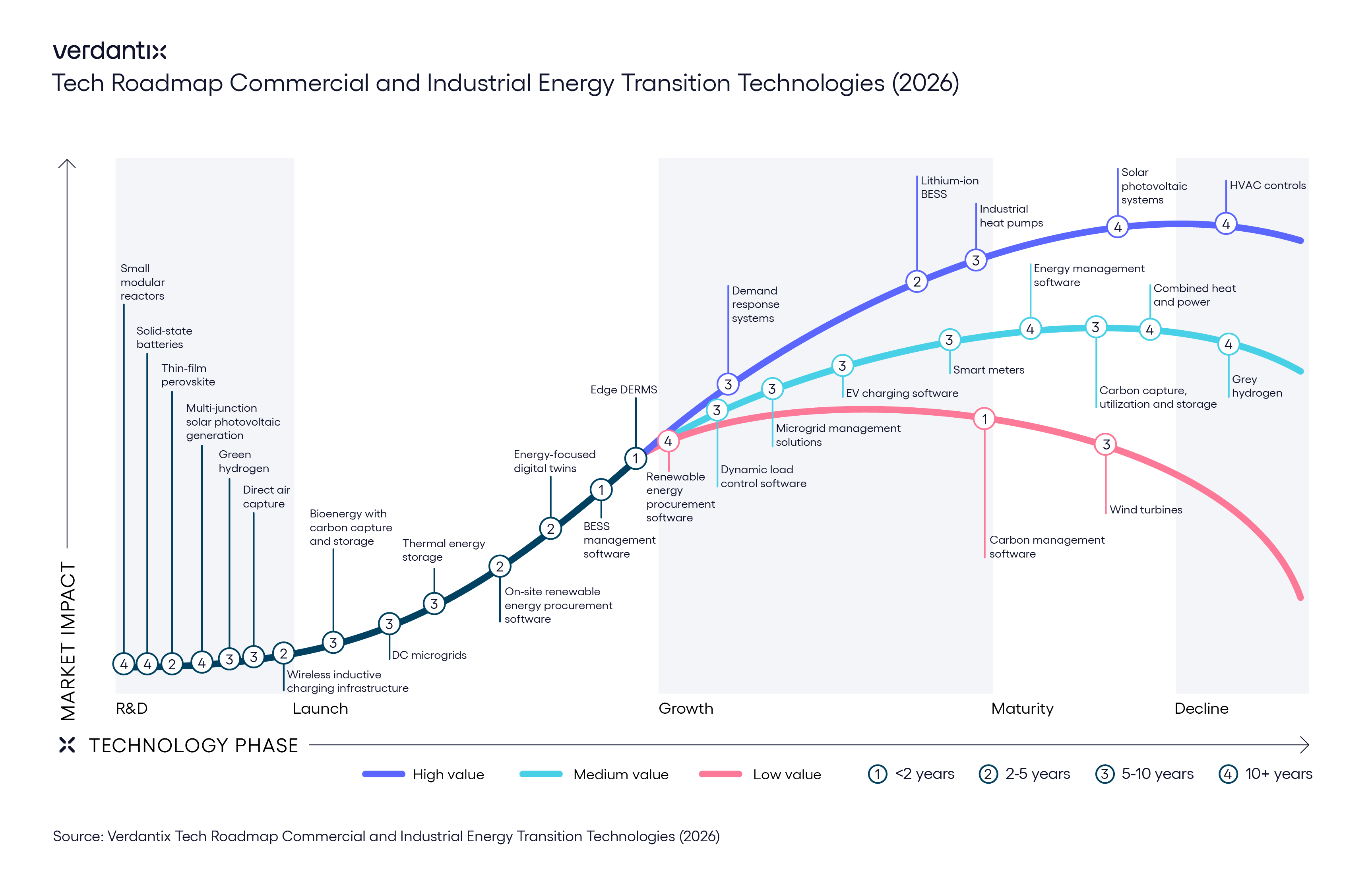
Taken together, these technologies also show what organizations need to address energy transition technology effectively: better visibility into energy use, more flexible control over demand and a clearer way to integrate new assets into wider operational planning. In most cases, the goal is not to adopt a single ‘cutting-edge’ tool in isolation. It’s to build a more coordinated energy software stack that can help firms optimize cost, resilience and decarbonization at the same time.
About The Author

Gus Brewer
Consultant