From APIs To Agents: The Next Disruption In Carbon Management?
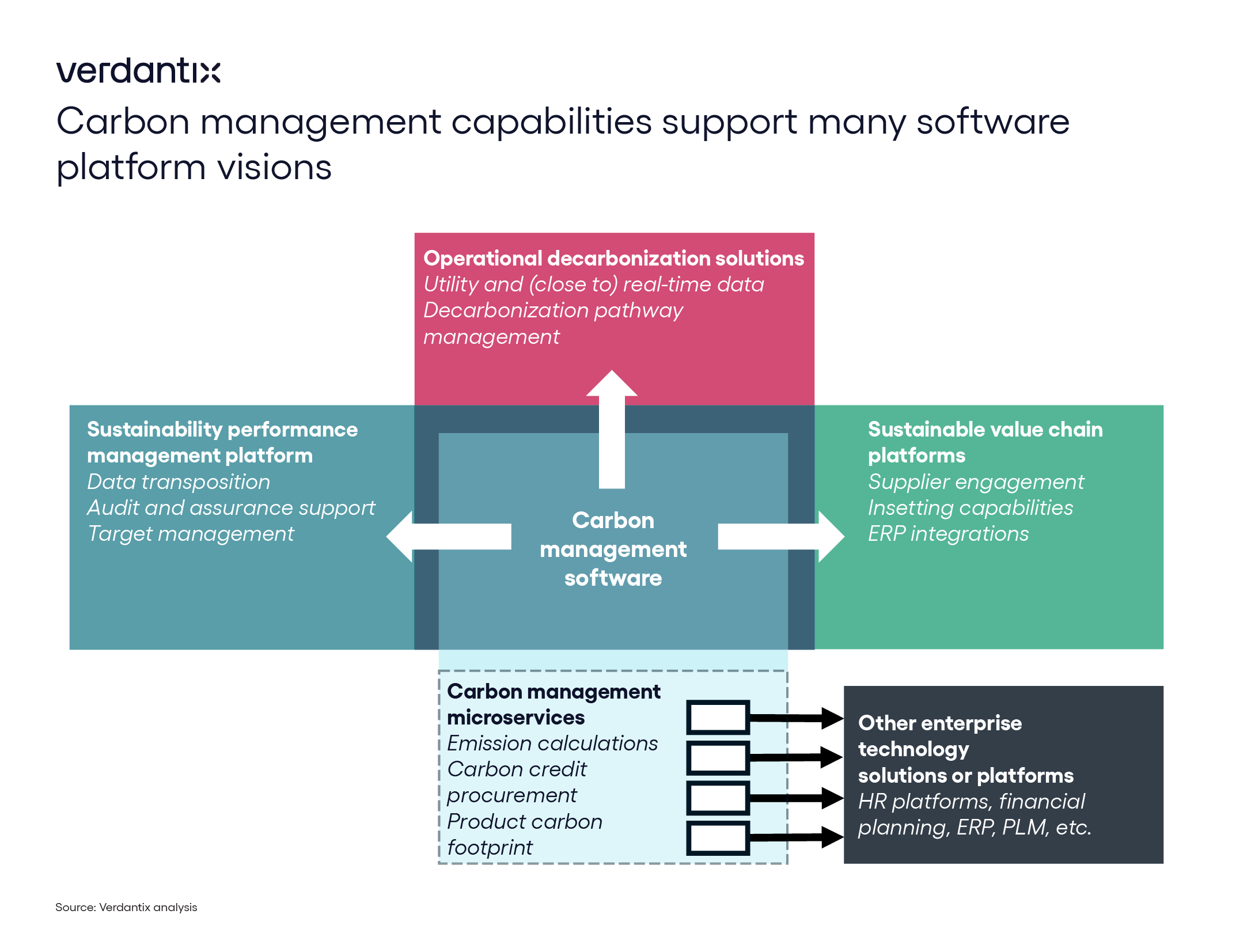
Verdantix research has consistently pointed to a structural shift in the carbon management software market, as standalone software gives way to more integrated, platform-driven approaches. For much of the past decade, carbon management solutions have operated as central hubs: data are collected, emissions are calculated and outputs are used primarily for reporting. That model made sense in a market driven by disclosures and enterprise-wide inventories. However, the focus is now moving towards operational decarbonization, where emissions data need to inform decisions as they happen, rather than sit within reporting workflows.
In late April 2026, IBM announced the general availability of its Envizi Emissions API, designed to let firms embed emissions calculations directly into their existing systems rather than relying solely on a standalone sustainability platform. Built on a calculation engine developed over several years, the API combines Envizi’s emission factor datasets with centrally managed calculation logic and selection algorithms, allowing organizations to generate consistent emissions results across different use cases.
This kind of capability directly addresses where decarbonization decisions are actually made: they happen in procurement systems, supply chain tools and capital planning workflows. APIs offer a way to bring carbon data into those environments. Developer-first providers such as Climatiq have been building around this model since 2021, allowing emissions to be calculated directly within other software. IBM’s entry into this space with a generally available solution suggests that embedded carbon capabilities are moving beyond API-native providers and becoming part of broader enterprise software strategies.
However, the API layer is only part of the story. As organizations move towards more granular use cases – such as product carbon footprinting – a more fundamental issue is becoming visible: the state of the underlying data. Emission factors remain fragmented across multiple sources, with different structures, levels of detail and update cycles.
This is where a newer set of providers is starting to focus. Firms such as Ecodex are building tools to aggregate and standardize emission factor datasets, providing a consistent foundation that sits underneath calculation engines. Rather than competing directly with APIs, they address a different problem: making the data usable, comparable and easier to manage. Taken together, this points to a gradual unbundling of the carbon stack into separate layers: data, calculation and reporting.
A further development is the emergence of agentic AI. Many carbon software providers are starting to build AI assistants directly into their platforms, but a second model is beginning to take shape. As APIs and data layers mature, organizations may increasingly develop their own internal agents, designed to sit within their existing systems and orchestrate interactions between operational data, carbon APIs and underlying datasets.
In this model, carbon intelligence is not accessed through a single interface, but retrieved dynamically as part of broader workflows. While requirements for auditability and regulatory alignment are likely to limit fully autonomous decision-making in the near term, this direction reinforces the shift towards more modular architectures where data, calculation and orchestration are decoupled.
For now, the more realistic outcome is a hybrid architecture. Carbon calculations are increasingly distributed across operational systems, supported by APIs and emerging data layers, while CMS platforms retain a central role in governance, consolidation and reporting.
To learn more about this topic, tune into our Future Of Digital Decarbonization Technology webinar.
About The Author
.png?sfvrsn=db470322_1)
Alessandra Leggieri
Senior Analyst