As The CFD&A Market Evolves, Buyers Are Becoming More Independent And Discerning – Raising The Bar For Vendors
Buyers are moving beyond packaged outputs towards raw data, transparency and multi-vendor strategies, forcing providers to rethink how they deliver value in an increasingly complex and fragmented market.
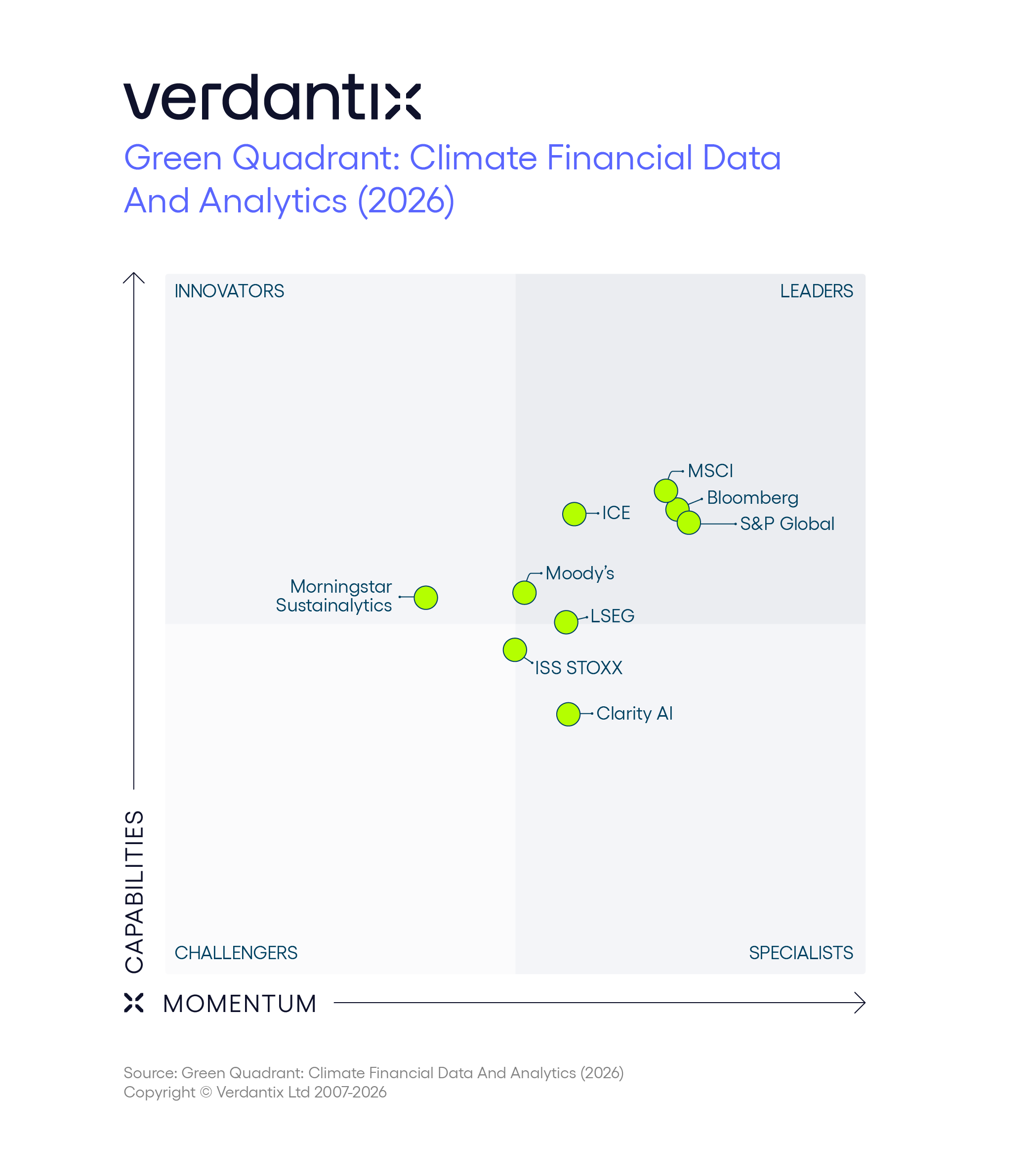
The second iteration of the climate financial data and analytics (CFD&A) Green Quadrant is here, featuring nine vendors. Our analysis draws on a 96-point questionnaire, live product demonstrations and 12 in-depth buyer interviews, supported by desk research.
It’s no surprise that the sustainability and climate policy landscape is shifting. The US remains fragmented with state-specific regulations, and the EU is recalibrating key frameworks such as the SFDR, the CSRD and the EU Taxonomy. At the same time, 36 nations have adopted or signalled plans to adopt ISSB standards.
This fragmentation places increasing strain on vendors and financial institutions as they work to keep pace with evolving requirements. Though regulatory compliance remains a core driver of purchasing decisions, it is no longer the only one. Firms are also focused on building resilience to physical risks and capturing transition-related opportunities. Across these use cases, data quality, full portfolio coverage and auditability remain paramount.
Financial institutions are becoming more independent
Though climate maturity varies, the buyers we spoke to demonstrate a growing level of independence. Firms are increasingly prioritizing raw data and data feeds to integrate into in-house systems, whether to support internal ESG scoring, retain IP or enable AI-driven climate analytics.
Metrics such as implied temperature rise (ITR) and climate value at risk (CvaR) remain useful, but buyers are placing greater emphasis on transparency. They are challenging vendor methodologies and leveraging the underlying inputs behind these metrics. We are also seeing growing interest in integrated approaches, particularly combining transition and physical risk within CVaR frameworks to provide a more holistic view of exposure.
Multi-vendor ecosystems are the norm, but incumbents have the edge
Buyers are becoming more selective, adopting a best-of-breed approach for specific climate and sustainability use cases. However, vendors with established relationships retain a clear advantage when it comes to embedding sustainability and climate data into existing client workflows. Regardless of the data source, vendors must ‘play well’ within broader ecosystems, as buyers prioritize providers based on specific strengths and integration capabilities.
Interest in AI and nature data is growing, but not yet core
While vendors continue to advance AI-driven climate analytics, it is not yet a primary driver of purchasing decisions. For many buyers, AI remains a ‘nice to have’ and, in some cases, adds governance complexity. Nature data are also gaining attention, but adoption remains early-stage and is not yet central to investment workflows.
Focus is shifting to granular risk and opportunity
Vendors are strengthening asset-level and geospatial capabilities, enabling financial institutions to assess physical risk at the facility level. Buyers are increasingly using these tools in due diligence, particularly for infrastructure deals, though challenges remain around pricing risk and building methodological trust.
Transition risk – though less prominent in headlines – remains on buyers’ agendas. Trust in transition risk data is more established, with strong uptake, particularly in Europe, for reporting, portfolio alignment and issuer engagement. At the same time, transition-related opportunities are gaining traction, supported by advances in proprietary scenarios and commodity-linked transition data.
As buyer expectations continue to rise, vendors can no longer rely on packaged outputs alone. The shift towards raw data integration, greater methodological scrutiny and multi-vendor ecosystems means providers must rethink how they deliver value, while buyers must ensure their data strategies are equipped to support increasingly independent and sophisticated workflows.
To learn more, read the full report: Verdantix Green Quadrant: Climate Financial Data And Analytics (2026).
About The Author

Felicity Laird
Principal Analyst