Iran War Challenges Gulf Ambitions To Embed AI In Operations, EHS And ESG

Moses Makin
As part of the 2025 Verdantix AI global corporate survey, AI, technology and IT budget-holders from the Gulf States were surveyed on their expectations for AI adoption across operations, EHS and ESG functions. A significant share – ranging from 38% to 52% – expected to have many highly automated processes with limited human input or have generative AI widely embedded in these teams in 2026.
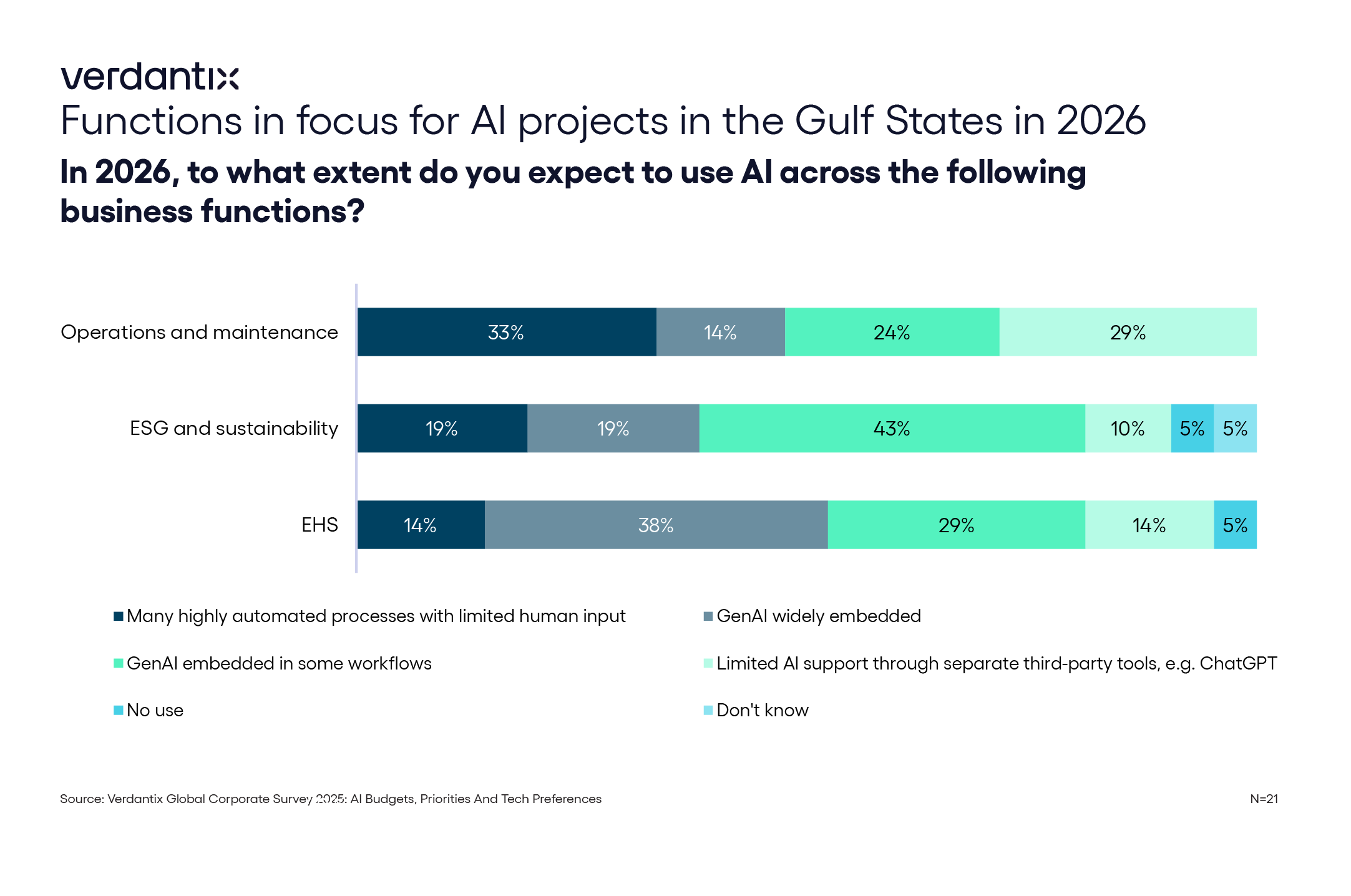
But how assured are these initiatives now? Escalations to unrest in the Middle East from February 2026 have featured direct attacks on Gulf technology infrastructure, fundamentally altering expectations for the region.
What does the short term hold?
Over the next 12 months, the Gulf’s investment in AI‑driven innovation is likely to be lower than reported in the Verdantix global survey. Technology spending is closely tied to the capital available to operational teams, and ongoing uncertainty around physical damage and the durability of the ceasefire (at the time of writing) is prompting leaders to defer planned investments. As of March 2026, there have been reports that the Gulf energy sector faces a repair bill totalling at least $25 billion. This will materially limit any immediate transformation plans.
Moreover, the strikes on digital infrastructure in the region have created short-term uncertainty about the scale of AI deployment in the Gulf. These events have raised concerns about the resilience of local data hosting, prompting some organizations to consider relocating their data. Relocation is especially problematic for low-latency AI use cases, such as video analytics for safety, where performance depends on close proximity between users and data centres, meaning relocation could reduce effectiveness.
What does the long term hold?
Assuming geopolitical stability is restored, the Gulf is likely to maintain its strong trajectory in expanding AI adoption. The region’s underlying momentum is underpinned by significant levels of planned domestic AI infrastructure buildout.
In 2025, Saudi Arabia launched HUMAIN to deliver next-generation data centres, AI infrastructure and cloud capabilities. Qatar has established a $20 billion joint venture to expand national AI infrastructure, while the UAE is developing Stargate UAE, positioned as the largest AI campus outside the US.
These projects will enable the region to run compute-intensive workload at lower marginal cost than many other regions, reducing the cost base for vendors. If these costs savings are passed onto buyers, AI will become more commercially viable and, in turn, more accessible to organizations operating in the region.
Moving forwards
Verdantix continues to run global corporate surveys with a strong response base of practitioners from EHS, industrial transformation, real estate, AI and sustainability domains based in the Gulf States, providing insights on their budgets and technological deployments for the upcoming year. The 2026 surveys provide a valuable benchmark for organizations seeking to assess whether the region is pressing ahead with its AI innovation, despite geopolitical tensions.
Firms managing AI or broader digital transformation initiatives in the Gulf – and looking to assess the impact of the conflict – should consider setting up an analyst inquiry call to gain clarity on how best to respond.
To read more, check out our blog on the importance of scenario modelling to understand how the Middle Eastern crisis will impact firms’ operations and financial positions.
About The Author
Moses Makin
Industry Analyst