Frontier Model Builders Spend Big On Forward-Deployed Engineers – Should SaaS Vendors Follow Suit?
Agentic AI deployment is changing how enterprise value is created from solution deployment. Emphasis is now placed on workflow transformation, not simply model development. At the same time, low-cost open-source alternatives are putting pressure on frontier model developers’ API-led revenue strategy. These factors are forcing vendors to look for new growth, monetization and retention strategies.
One possible route is investment in forward deployed engineers (FDEs). Since March 2026, Anthropic, AWS, Microsoft, OpenAI and others have committed over $5 billion to set up separate FDE business groups or organizations. This will provide a foundation to expand the serviceable addressable market (SAM) for tech providers by engaging deeply with enterprise customers and building more verticalized solutions, while also creating structural reliance and stickiness by moving from API access (with low exit barriers) to workflow integration (with significant friction).
Alarm bells should be ringing for SaaS vendors. Enterprise buyers are already exploring frontier model platforms as an alternative to purchasing software (see NVIDIA NemoClaw Emerges As Another Disruptive Force In The SaaS Market) and the addition of FDEs is likely to add further weight to this threat. At the same time, demand for implementation support is growing rapidly: approximately 47% of CIOs strongly agree that they prioritize vendors that offer co-development and FDE-led engagement models; signalling that demand is moving away from product-led growth (PLG) (see Global Corporate Survey 2026: AI Budgets, Priorities And Tech Preferences).
SaaS vendors should heed these warning signals and carefully assess the cases for and against investing in FDEs:
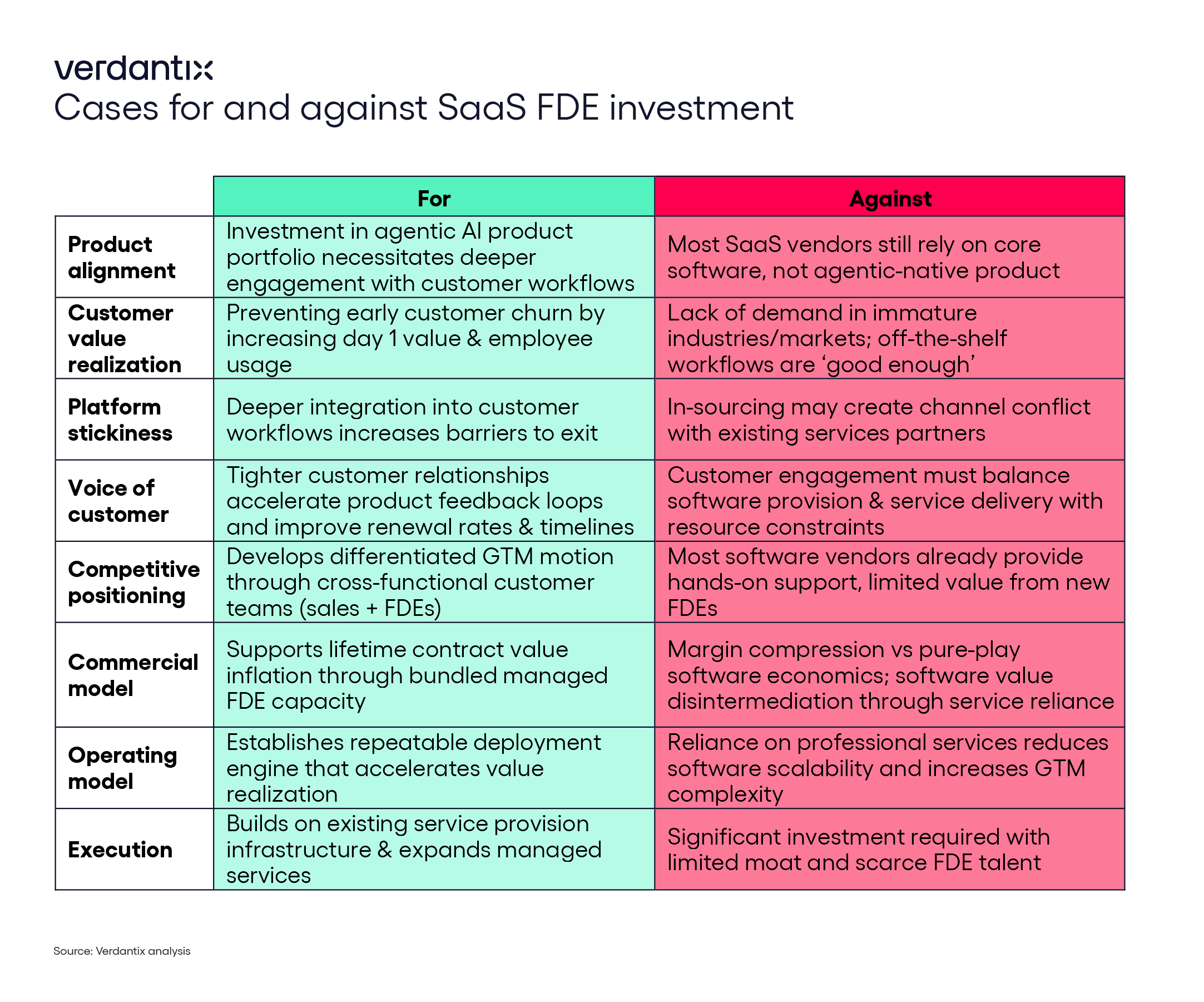
SaaS PLG will decline as agentic AI value creation hinges on implementation, not just model quality. But delivering ‘in-house’ FDE services may not be the answer for all software vendors. Some providers should instead consider:
- Building an AI strategy service team.
Through a dedicated AI strategy team, vendors can help customers identify high-value agentic AI opportunities, prioritize workflows for automation and define business cases. These services are typically higher margin and less talent-intensive than technical deployment, making them easier to scale. StackAI (recently acquired by Asana) has developed a combined proposition that integrates strategists with FDEs. For SaaS vendors, this provides a low-friction entry point for AI service-led growth, while preserving implementation partnerships with system integrators and consultancies.
- Leveraging third-party FDE providers.
Bringing FDE capabilities in house is not essential for every vendor. While large enterprise customers may value direct engagement, many deployment and transformation needs can be met through systems integrators, consultancies and specialist FDE providers. Expanding and formalizing these partnerships can provide scale without significant internal investment.
- Driving deeper co-development and collaboration initiatives with ideal customer profiles (ICPs).
Collaborating with strategic customers to identify target workflows, validate use cases and test early proofs of concept. Enterprises place a high value on co-development initiatives as they view them as an opportunity to influence vendor roadmaps.
- Exploring bundled managed services with FDE hours.
Rather than selling FDE engagements as one-off implementation services, vendors can integrate them into a recurring managed service model alongside AI strategists, system integrators and others. This enables a shift from selling software to delivering outcomes, while preserving and potentially increasing customer ARR, reducing churn through ongoing adoption support and blending well with existing partner delivery models.
For more on trends and developments in AI, check out the Verdantix Insights page.
About The Author

Reece Hayden
Senior Analyst