Industrial Transformation Trends That Will Define 2026
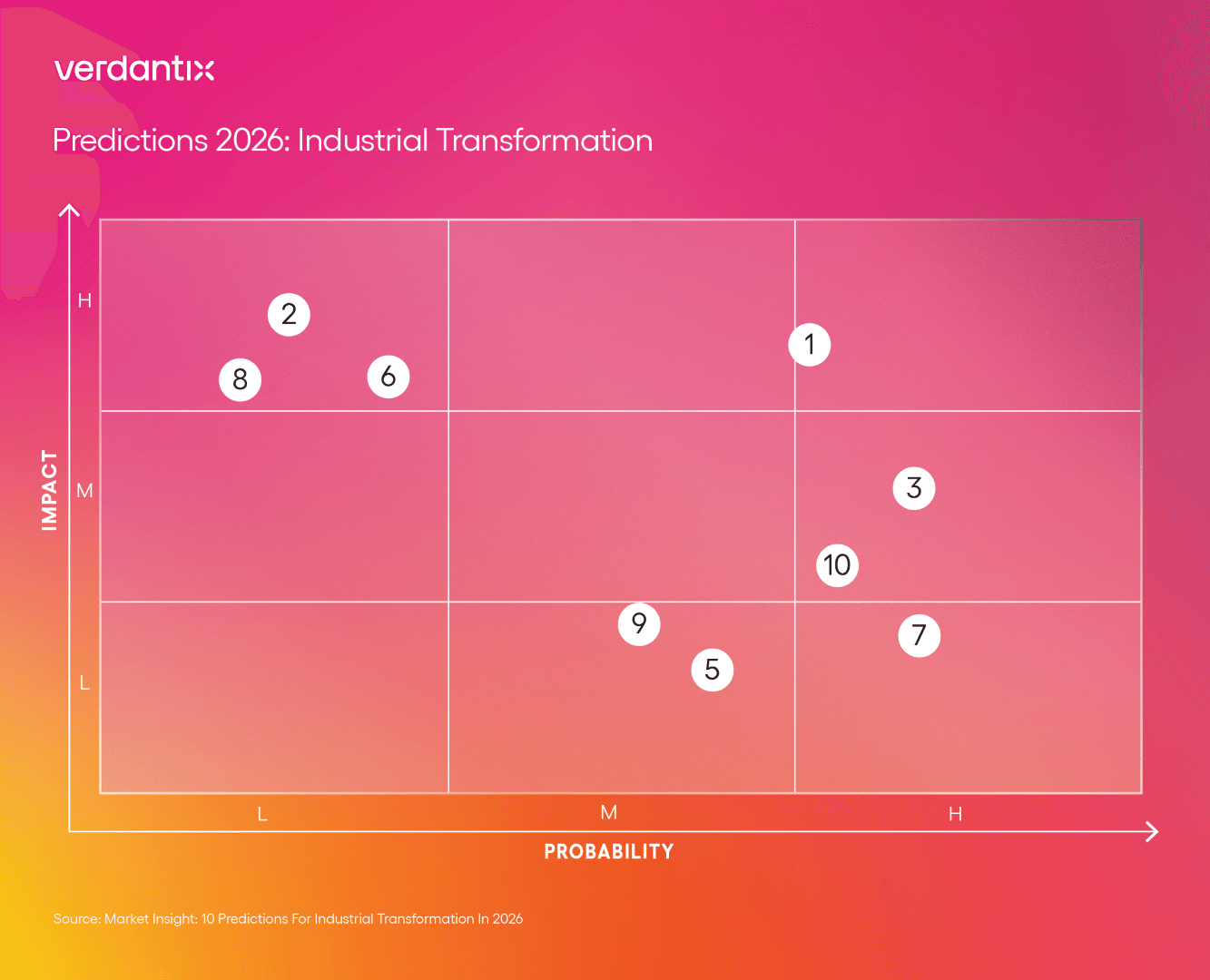
As firms move into 2026, industrial technology carries real momentum against a backdrop of supply chain uncertainty and geopolitical noise. This landscape has made industrial agility not only non‑negotiable but also more immediate: it is no longer a long‑term ambition. Industrial leaders need to feel agility in their everyday operations, in shorter decision cycles and in systems that flex with disruption. They want tools that improve judgement efficiency, not slow it down. Many firms have already the digital foundations in place: the pressure is now turning that investment into something that changes day-to-day work. From our 10 predictions for industrial transformation in 2026 report, Verdantix analysts have highlighted three trends that will shape the road ahead for industrial organizations:
1. Industrial AI analytics will hit a tipping point.
Industrial AI analytics spending is set to reach nearly $4 billion in 2026, marking a move from scattered pilots to AI embedded in daily operations. The acceleration is strong enough to create two new unicorn vendors, helped by rising private equity interest in fast‑growing firms like Augmentir and SymphonyAI. Meanwhile, AWS and Microsoft are expanding marketplaces that make deployment faster and more repeatable, and buyers want analytics that compress sensing, interpretation and action to support frontline decisions. With simpler integrations and more scalable models, analytics will begin shaping routine operational workflows instead of sitting unused at the edges of the plant.
4. Robotics will have its ‘ChatGPT moment’.
Robotics is entering a phase similar to the generative AI surge that reshaped software. Foundation models now let robots learn tasks from vision and instruction instead of rigid pre‑coded logic, creating a shift comparable to the ChatGPT explosion. Use cases from Arm and Hyundai are accelerating progress, enabling robots to leave fixed production lines and work in less predictable, mixed environments where agility matters. Instead of long reprogramming cycles, firms will adapt robots to short runs, variable conditions and frontline support work. By 2026, adaptable robots will help organizations cope with the constant variability that has become part of modern manufacturing.
10. Persona-based AI agents will become standard.
Persona‑based AI agents are becoming standard across maintenance and reliability workflows. Early deployments from AWS, IBM and Microsoft show how they automate recurring tasks and surface contextual insights from asset histories and sensor behaviour. Vendors like Cognite and IFS are expanding into this space with tools that pair strong data integration with role‑specific guidance. These agents give technicians a digital teammate that speeds up triage, highlights emerging risks and lifts less experienced staff to higher‑quality decisions. As labour shortages intensify, these agents will start influencing reliability decisions the moment they arise, which is where most firms still struggle.
These three predictions point to a shift toward industrial agility, faster decision cycles and technology that meaningfully supports frontline work. The full Verdantix report covers seven additional predictions on cyber security, pricing models, professional services, open frameworks and factory system evolution. To understand the complete landscape and how industrial agility will shape digital strategy in 2026, read the full report, Market Insight: 10 Predictions For Industrial Transformation In 2026 And Beyond, and catch the webinar on demand here.
About The Author

Oliver Bridges
Analyst