The EHS Agent Arms Race Is Already Over
Executive Summary
AI agents are now standard in EHS software, meaning the number of agents a platform offers no longer sets it apart from the competition. Instead, the next advantage lies in orchestration: coordinating agents, data and workflows to complete EHS programmes end to end, from incident report to verified closure. Adoption is still at an early stage, with only 20% of firms running multi-agent orchestration platforms – but 41% plan to pilot the technology in 2027. Value will go to the platforms that own the workflow, grounded in EHS expertise and governed with the same rigour EHS teams already apply to high-risk work. Buyers should judge platforms on the programme outcomes they deliver, not on agent counts or marketing claims.
Agents are quickly becoming table stakes for EHS platforms
Since 2023, AI has moved from pilot to product across the EHS market, and AI agents are fast becoming a standard feature. As providers commoditize agents, competitive advantage is shifting from how many agents a platform offers to how effectively agents, data and processes work together. That coordination layer, or ‘orchestration’, will define the next generation of EHS platforms.
“Every problem can be analysed and solved through digital solutions, and the participation of artificial intelligence has been paramount in the last two years to really offer us potential solutions that change the game in our favour.”
– EHS Director, Food and Beverage Manufacturing
Four trends define AI in EHS
AI functionality is still relatively new compared with EHS product suites that have been on the market for more than two decades. However, a clear set of capabilities has already become table stakes. Verdantix recognizes four trends defining this AI foundation for EHS solutions, with:
- AI-native experiences becoming the primary interface for work.
Users accustomed to Anthropic’s Claude, Microsoft Copilot and OpenAI’s ChatGPT now expect to interact with EHS software via conversation, opening the platform to every user regardless of EHS expertise.
- Operational AI combining structured and unstructured data.
Once confined to pilots, operational AI tools such as agents are now valued for their ability to combine structured and unstructured data. This allows individuals to automate reporting, summarize documents, draft incident descriptions and analyse images, returning productive hours to users.
- Specialized agents becoming baseline, and expected to deliver value out of the box.
Some 57% of firms have already rolled out commercial AI agent application platforms (see Verdantix Global Corporate Survey 2026: AI Budgets, Priorities And Tech Preferences). As they further commoditize, quality and strategic relevance matter more than quantity of agents, with the strongest platforms offering a well-aligned mix of operational agents (for example, for report creation) and specialized agents (for processes such as corrective and preventive actions (CAPAs) and permit management).
- AI extending EHS into quality, risk, sustainability, maintenance and enterprise resource planning (ERP).
Agents are now expected to act across domains – such as raising a work order after an incident. However, they only deliver enterprise value when they work together, which is where differentiation is heading.
“You cannot underestimate how important interoperability is. We have different software for various tasks and areas. It will be very beneficial to have everything incorporated into one and we are having conversations about this currently.”
– EHS Leader, FMCG Manufacturing
The next frontier for EHS AI is intelligence and orchestration
With a foundation of core capabilities in place, AI-enabled EHS ecosystems are becoming increasingly interconnected. Differentiation is shifting from individual AI capabilities towards coordinated intelligence and orchestration across systems, workflows and business functions. The market should expect:
- Connected operational intelligence to fuel modern EHS ecosystems.
As AI spans more EHS domains and connects more systems, EHS ecosystems are coming to rely on an operational intelligence layer spanning quality, sustainability, risk, operations and enterprise performance (see Figure 1). This layer will provide centralized and secure data exchange, so that connected systems can use the information and act on it. It will also improve cross-domain visibility and reporting, turning insight into action on the ground. In doing so, it will help dissolve the silos that have long fragmented EHS and enterprise operations.
“I don't think the long-term market is simply EHS software. I think we're moving towards connected operational risk platforms that bring together safety assets, supply chain and logistics, management workforce contractors, sustainability, quality compliance and operational resilience.”
– Senior Programme Manager, Technology
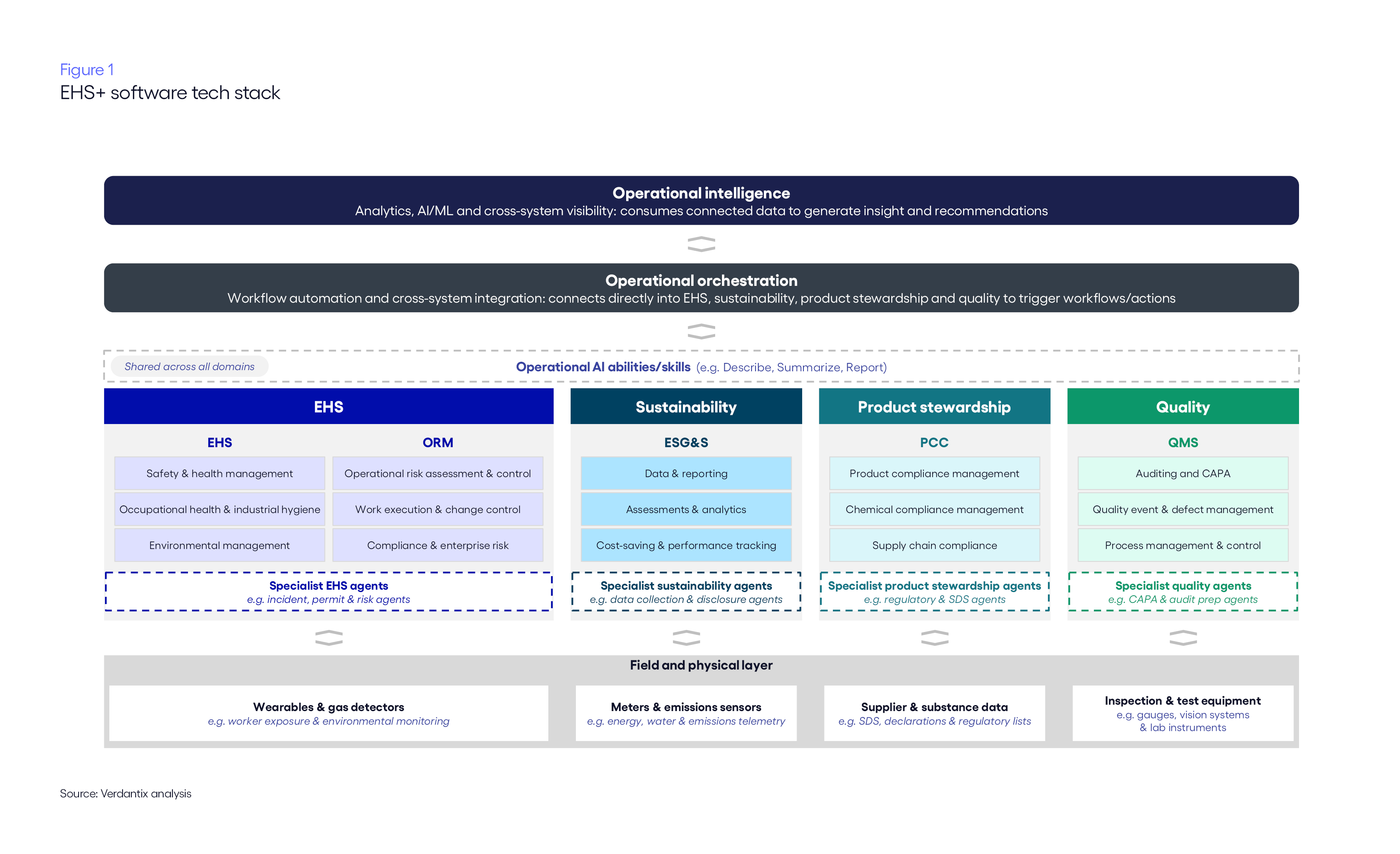
- Programme-level coordination to supersede task-level automation.
EHS customers are increasingly demanding EHS AI capabilities that can manage end-to-end processes. The strongest solutions must cover a wide range of EHS AI functionality and ensure that those capabilities are well aligned and work together seamlessly. Leading solutions will therefore provide either native EHS AI capabilities that offer a consistent end-to-end experience across workflows, or well-integrated functionality that supports a best-of-breed approach.
- An orchestration layer to emerge, connecting systems, workflows and decisions.
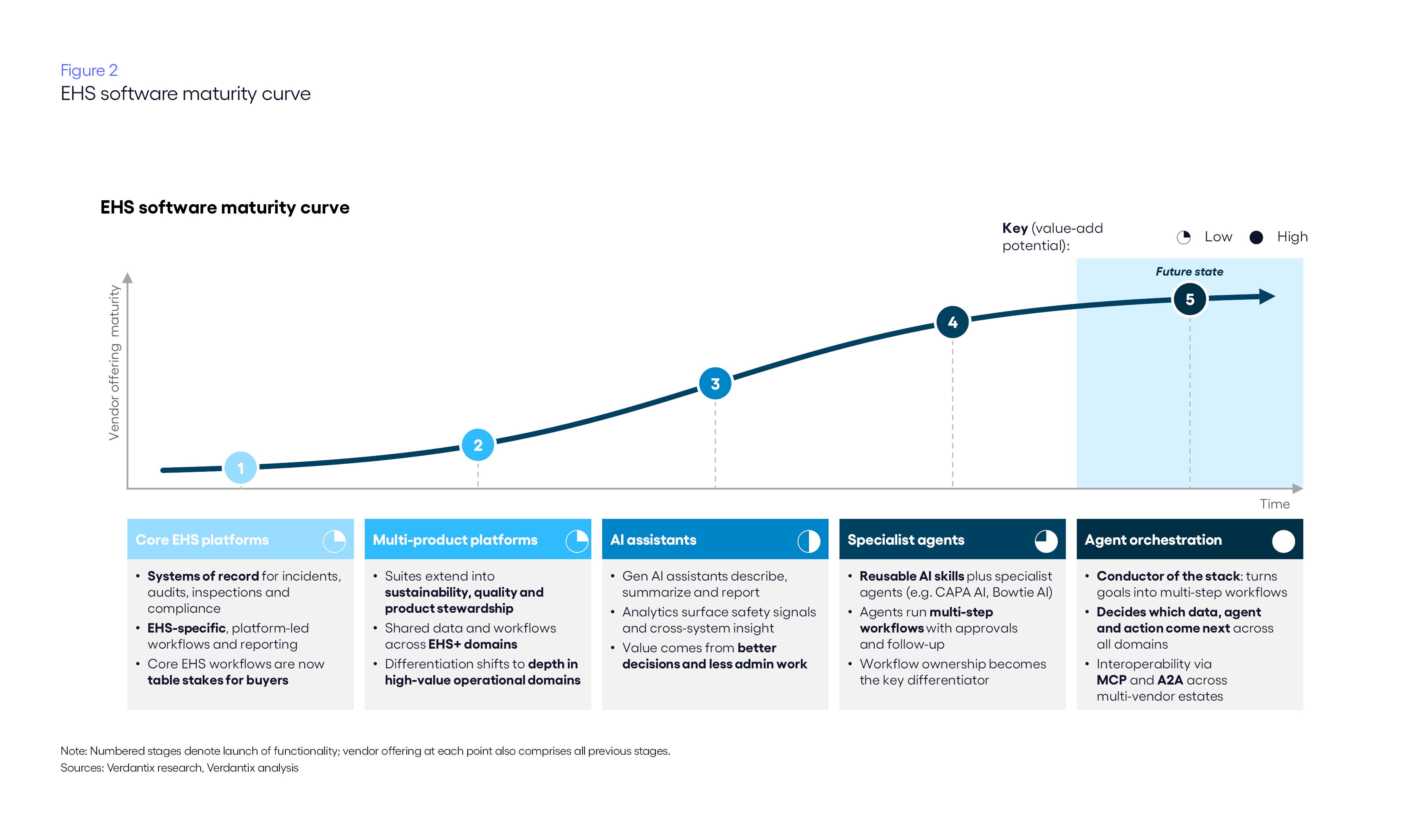
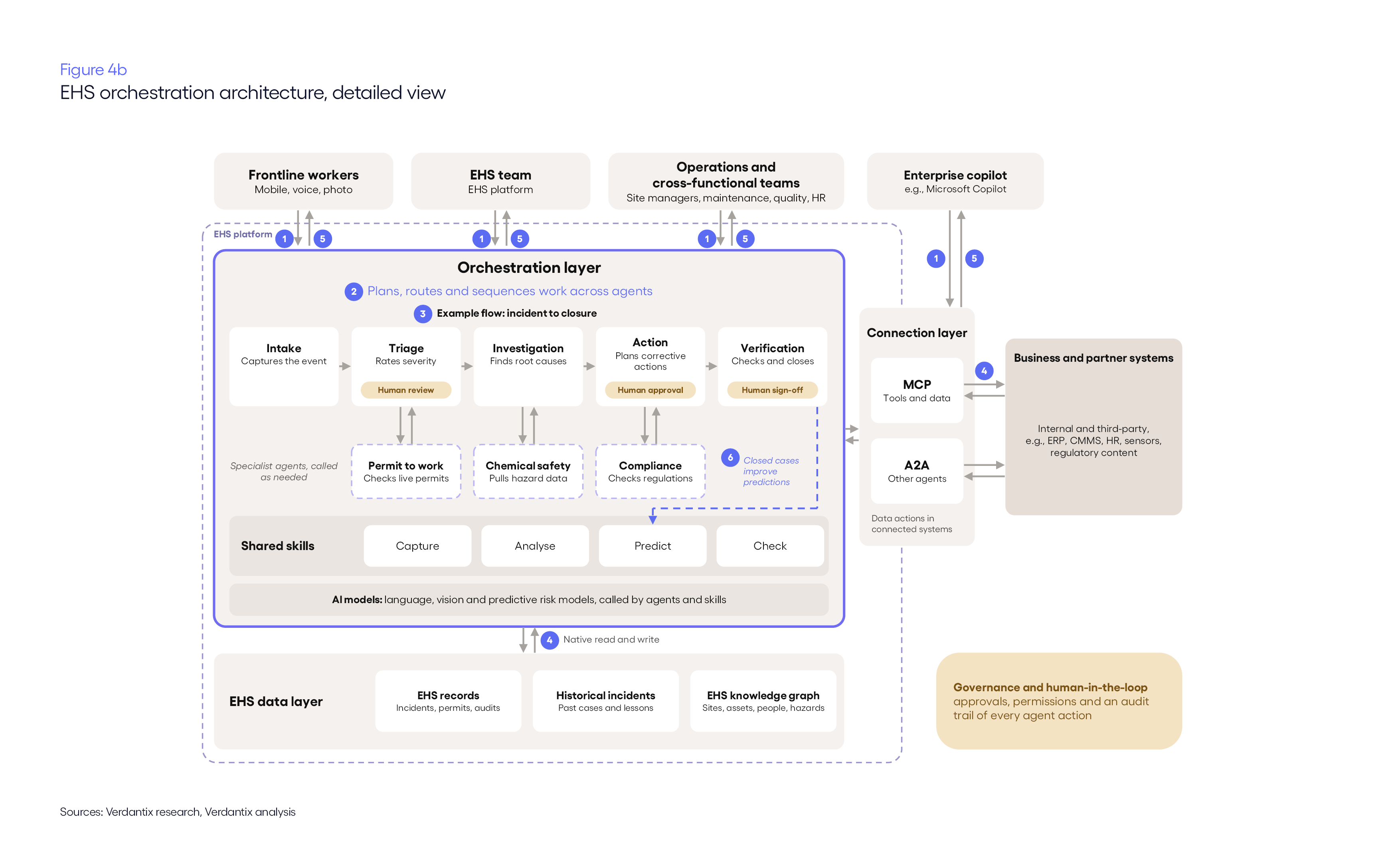
The orchestration layer will be the conductor of the technology stack: sitting between intelligence and domains, turning goals and objectives into multi-step workflows, tracking completion, routing work, and monitoring progress. The orchestration layer determines which data and agents should be used, and which action should occur next, operating across multiple functions. This represents the next evolution of EHS AI (see Figure 2). Only 20% of firms have rolled out multi-agent general orchestration platforms as of 2026, but 41% will pilot them in 2027 (see Verdantix Global Corporate Survey 2026: AI Budgets, Priorities And Tech Preferences).
"The orchestration layer decides which model to call, which data to retrieve, which agent or workflow to invoke, and what happens next… Current EHS platforms are increasingly building that centralized orchestration layer to manage multiple agents, models and workflows.”
– Senior Programme Manager, Technology
EHS capabilities will enable effective orchestration
Although true AI maturity is somewhat lagging, the marketing of AI capabilities paints a different picture. This makes it essential to understand the real value that can be gained from AI and where this originates. As orchestration matures, it will challenge several assumptions about where value lies in EHS AI, establishing that:
- Ownership of the workflow is what matters.
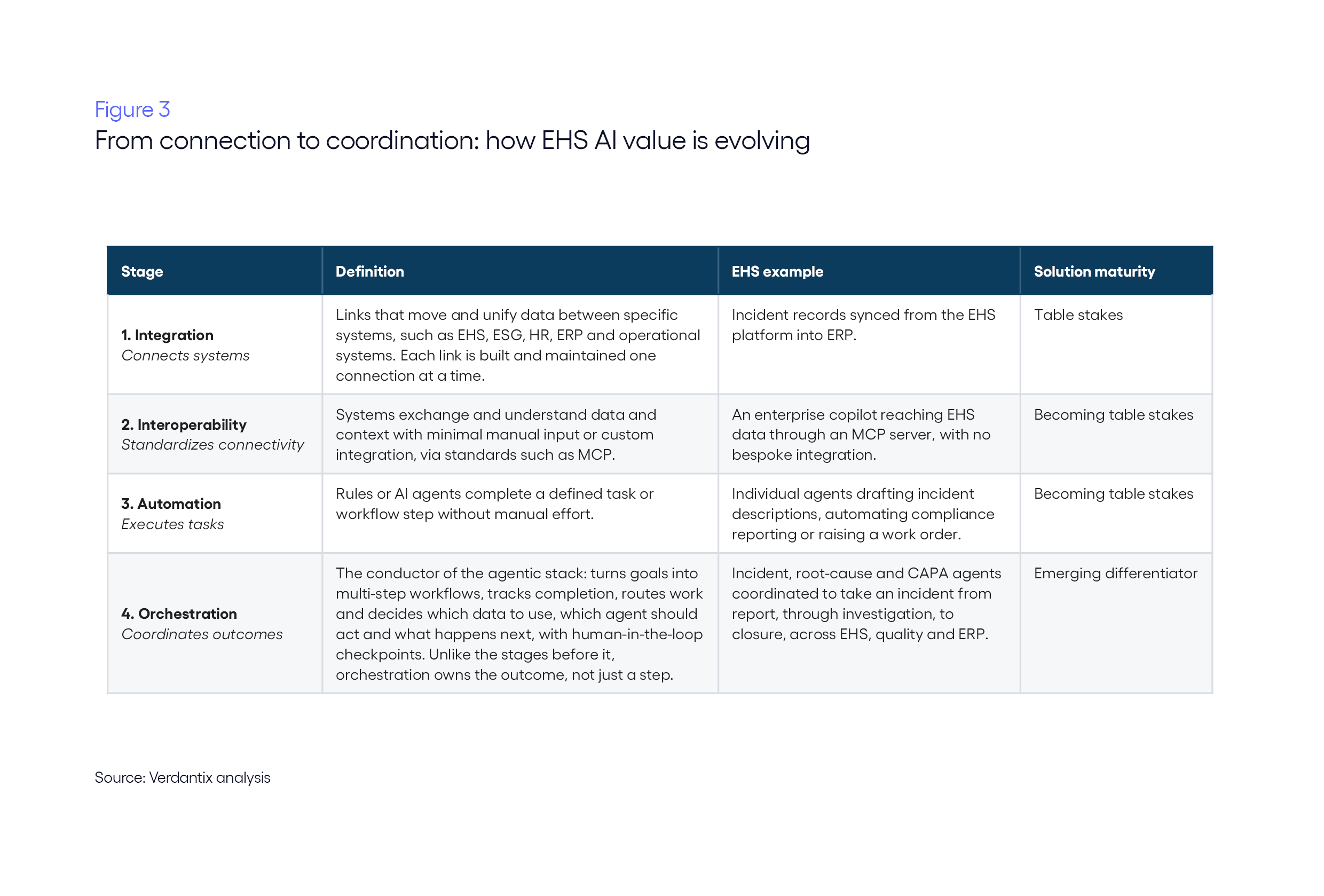
As Model Context Protocol (MCP) and similar standards make connecting systems cheap and repeatable, integration and interoperability will no longer be the factors setting platforms apart (see Figure 3). Verdantix calculates that 95% of enterprise software solutions are already MCP-compatible (or better), but only a few of these will be able to run the process. Long-term value will go to the platforms that own workflow execution and the decision logic that determines what happens next. Vendors that compete on connectors alone risk being disintermediated, reduced to a data source for someone else's orchestration layer.
- General-purpose LLMs are ill-equipped to run EHS programmes.
Two-thirds of organizations already use enterprise large language models (LLMs) and copilots in some capacity for EHS work (see Verdantix Global Corporate Survey 2026: AI Budgets, Priorities And Tech Preferences). But these models do not hold the incident history, permits, controls and regulatory obligations that define what is truly happening on site. That system of reality, and the expertise to act on it safely, sits with EHS platforms. Copilots may remain part of the interface, but EHS platforms must be the engine that executes and records the work.
- The value of orchestration is measured in outcomes.
Speeding up one step through task automation only moves the bottleneck to the next hand-off, and in EHS, most delays and lost actions sit between steps. By coordinating work across those gaps, orchestration makes programmes faster and more defensible, with value reaching operations, IT, finance and the board. Buyers should track programme-level outcomes, rather than time saved per task.
- AI governance is already part of the EHS skillset.
Most enterprises are scrambling to design controls for autonomous agents, yet EHS has spent decades governing autonomous, high-consequence work. Its frameworks translate directly: permit-to-work becomes a scoped, time-limited ‘permit to act’ for agents; lock-out/tag-out keeps agents isolated from safety-critical systems by default; management of change applies to every model or workflow update; and bowtie analysis maps how agent failures could escalate and which barriers stop them. EHS is well placed to set the standard for how agents are governed across the enterprise.
What EHS leaders should demand from an orchestration platform
As AI moves beyond individual capabilities, the strongest platforms will unify intelligence, agents, governance, interoperability and execution in a single architecture. Organizations evaluating next-generation EHS AI should test potential solutions against five key considerations, asking:
- Is the platform's intelligence grounded in EHS expertise?
Safety programmes should anchor the intelligence layer in their EHS platform, drawing in data from ERP and other systems. Agents must understand EHS context, regulations, workflows and operational requirements – knowledge that leading EHS providers have spent decades building. Relying solely on platforms without that heritage leaves a knowledge gap that undermines EHS programmes. Buyers should therefore make EHS expertise a core selection criterion.
“EHS software solutions are well positioned to coordinate AI workflows, as they understand EHS processes, models, etc. best. They have expertise in the EHS domain. But they do not need to be the sole owner of orchestration beyond that, as in large organizations, EHS is connected to other systems, such as ERP, which can also support.”
– Global Chief Information Security Officer, Industrial Manufacturer
- Can its agents coordinate end-to-end programmes?
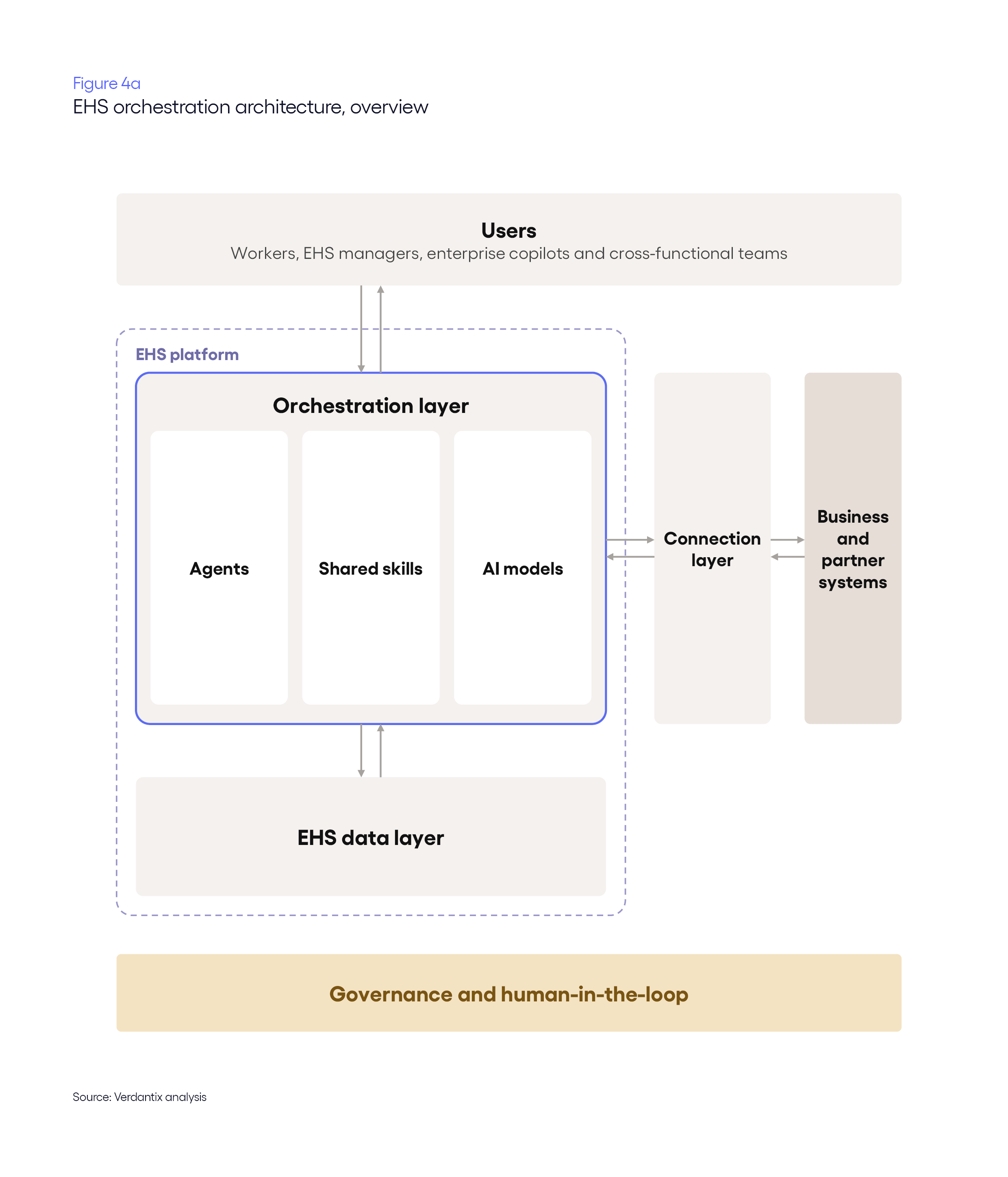
Most vendors are still focused on building individual agents that deliver value in specific workflows or tasks. However, the future technology ecosystem will revolve around orchestration. Enterprise outcomes depend on agents working together to execute multi-step workflows, significantly accelerating and simplifying EHS processes (see Figure 4a and 4b). Buyers should validate that a platform's agent library can coordinate programme-level work, to ensure that true value is delivered through AI orchestration.
- Does it provide visibility, control and accountability over agents?
As agent libraries grow and deployments scale, organizations need visibility and lifecycle management to keep every agent compliant and within scope. In a domain where an agent acting outside its scope can put people and plants at risk, safety must come first. Buyers should look for a centralized environment to manage every agent, with human-in-the-loop checkpoints that enforce accountability for key decisions and actions.
“We have a lot of questions about security and governance… [recent high-profile AI incidents] affect firms like us too… We also have concerns around agents. It is important to understand who is responsible and accountable, and there needs to be strong observability. We cannot lose control of plants and refineries – we would lose millions, affect population centres, etc.”
– CTO, Industrial Manufacturing
- Will it connect easily with the rest of the technology stack?
Intelligence and orchestration layers deliver value only if the stack beneath them – across EHS and other domains – is truly interoperable. MCP is fast becoming the open standard for connecting enterprise systems and workflows to AI. Third-party MCP servers will suffice in most cases, but native connectors from software providers can offer lower latency, higher throughput, fewer workarounds and greater data autonomy. As EHS becomes more central to enterprise operations, buyers should prioritize platforms that connect easily across the stack and ask vendors which connectors are native.
“Interoperability is very important. Most of the money we spend is in integrating new software products into our landscape. It is usually the biggest effort, so providers need to bring connectors to integrate rapidly into the system landscape of organizations. This is a big purchasing criterion.”
– Senior VP Digital, Data & AI, Energy & Utilities
- Does its marketed value match reality?
While EHS AI is still maturing, the value of agents is easy to overstate. Orchestration raises the bar further, as coordinating agents across systems and domains to deliver programme-level outcomes is an advanced capability with few current providers. Buyers should look past the marketing and seek evidence from providers that their agents and orchestration deliver measurable outcomes in EHS today, for the workflows and processes that matter to them.
About the Authors

Dayann Charles
Senior Manager, Advisory Services
Dayann is a Senior Manager in the Verdantix Advisory Services practice, with extensive experience leading strategic projects across the Verdantix landscape. He specializes in ...
View Profile
Nathan Goldstein
Senior Manager
Nathan is a Senior Manager at Verdantix, specializing in EHS software and the convergence of sustainability, EHS and operational risk. He leads research that helps corporate d...
View ProfileOther related content

Risk is moving faster and crossing more boundaries than EHS teams can manage with disconnected, manual processes alone. In 2027, leaders will need to anticipate threats across cont...
Upcoming / 19 January, 2027

AI is reshaping the economics and competitive dynamics of EHS software. As organizations explore in-house AI agents and bespoke workflows, vendors face growing pressure to demonstr...


Upcoming / 15 December, 2026

Fragmented technology ecosystems, poor data quality and complex legacy architectures stand between EHS leaders and the earlier risk detection that data and AI promise. New Verdanti...


18 November, 2026

Process safety incidents happen when risk signals go unrecognised in time to act. The challenge for many organisations is that their software is built to record what occurred rathe...


03 November, 2026

Autonomous vehicles are moving from experimentation into real-world operations, but adoption is progressing at very different speeds across industries and geographies. Mining has b...
12 October, 2026