Market Insight: 12 Innovative Platforms Advancing Enterprise Graph Technology
Executive Summary
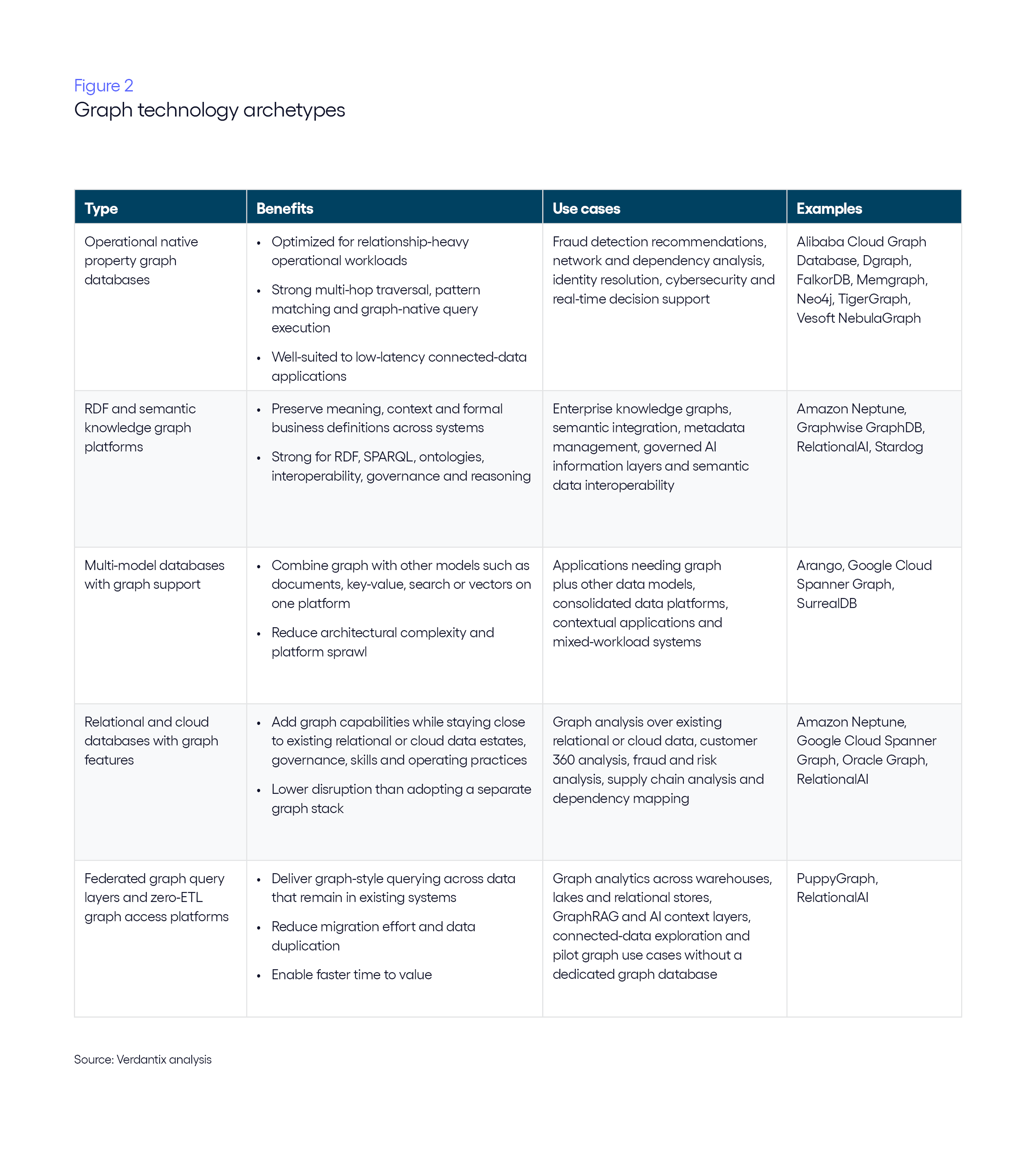
Buyers of graph technologies should use this report to evaluate emerging product strategies, architectural trade-offs and vendor innovation across a fragmented market. The report spans vendors offering native graph databases, semantic knowledge graph platforms, reasoning-led providers, graph capabilities embedded in broader database environments, and zero-ETL graph query layers. Together, they demonstrate that innovation in this space is no longer defined solely by traversal speed or graph query support. Instead, vendors are advancing different approaches to improve connected-data analysis, strengthen AI grounding, accelerate fraud and risk detection, reduce investigation effort and create a more governed enterprise context for decision-making. Software providers, cloud platforms and services firms can also use this report to identify partnership opportunities and better understand how peers are responding to growing demand for graph-enabled AI, semantic interoperability, GraphRAG and connected-data applications. The selected vendors illustrate the range of strategies shaping the future of enterprise graph, knowledge and context infrastructure.Figure 2. Graph technology archetypes
Summary for decision-makers
- Graph technology providers are not part of one uniform market. Buyers should distinguish between graph-native, semantic, multi-model, relational and zero-ETL approaches before shortlisting vendors.
- The strongest business value comes from improving knowledge integration, AI grounding, fraud detection, investigation speed and connected-data analysis across fragmented enterprise data.
- Vendor differentiation increasingly depends on architectural fit, governance, interoperability and deployment model, not just traversal performance or query language support.
- Enterprises should align vendor selection with workload priorities, such as operational graph speed, semantic governance, platform consolidation or low-migration graph access over existing data.
- Graph and semantic technologies are becoming more important as enterprises build trusted knowledge and context layers for AI, analytics and real-time decision-making.
12 innovative platforms are redefining graph technology as critical infrastructure for enterprise AI
The rapid transition from experimental generative AI (GenAI) to production-grade agentic systems has exposed a critical flaw in enterprise data architectures: the lack of verifiable context. In the Verdantix 2025 global corporate AI survey, nearly two-thirds of respondents rank the modernization of data infrastructure as a top priority; this is driven in large part by over half of organizations reporting that a lack of explainability is actively slowing their adoption of AI (see Verdantix Global Corporate Survey 2025: AI Budgets, Priorities And Tech Preferences). Without a structured way to connect fragmented entities across systems, firms face slower investigations and untrustworthy AI outputs.
Consequently, graph technologies are evolving from niche tools to connective infrastructure for the modern AI stack, with implications for both buyers and vendors. In this report, graph technologies encompass graph databases, semantic knowledge graph platforms, graph capabilities embedded in broader database environments, and zero-ETL graph query layers. Graph databases remain a core category within this landscape. Verdantix defines graph databases as:
“A type of database that represents information as entities (nodes) connected by relationships (edges), where both entities and relationships can hold properties, making it especially effective for querying highly connected data.”
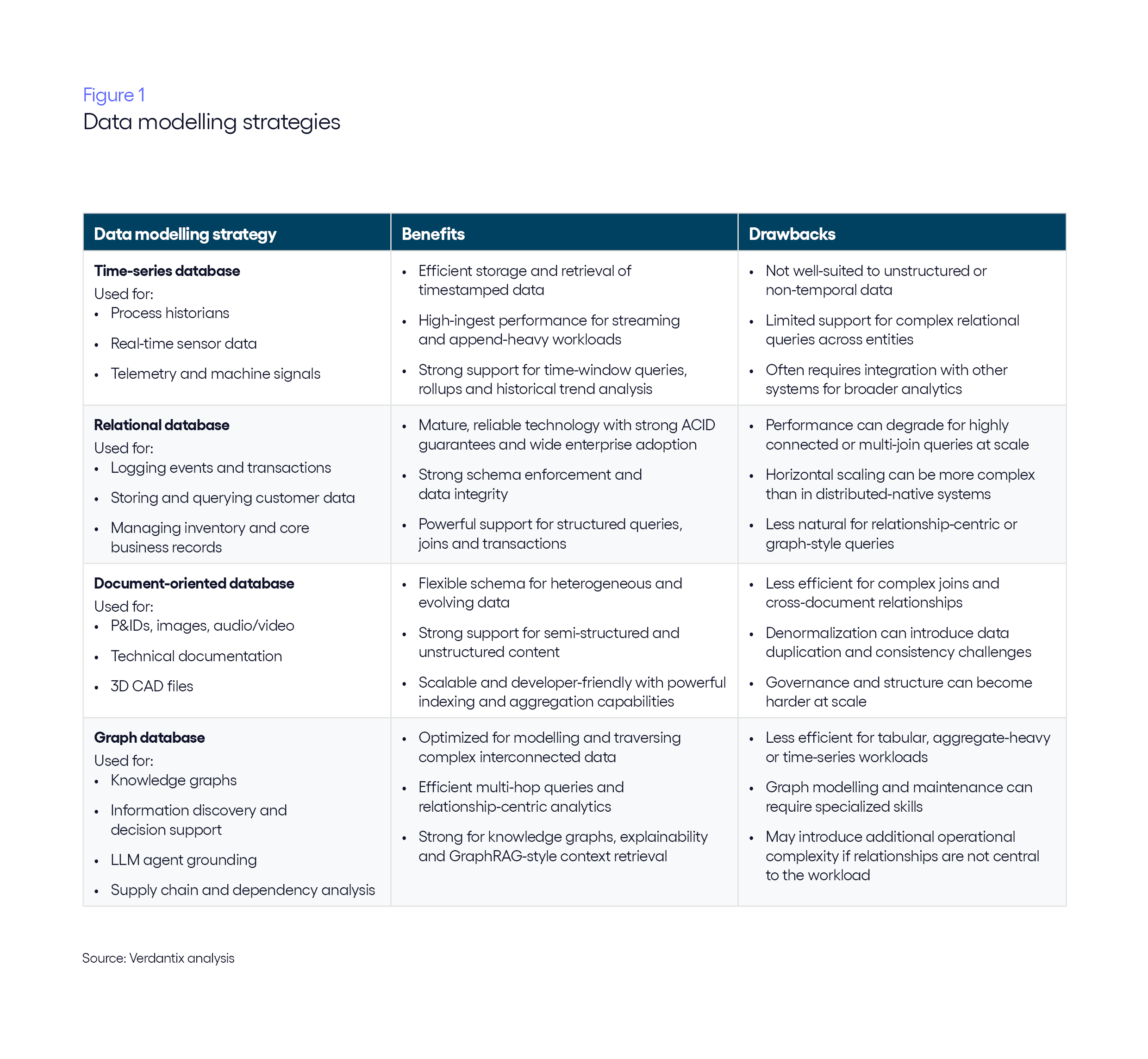
By embedding these capabilities into broader data ecosystems, graph database platforms are helping firms move beyond simple data storage to achieve deep, multi-hop analysis and stronger regulatory traceability (see Figure 1). These innovations improve data access and database performance and provide the grounding required for scalable, governed AI execution. Enterprise technology decision-makers and technical practitioners should use this report to identify which vendors can best bridge the gap between fragmented data and trustworthy, streamlined decision-making.
Graph technologies span multiple product archetypes, rather than a single, uniform database market
The vendors covered in this report should not be treated as participants in one uniform graph database market. Rather, they represent a broader graph technology landscape, spanning native graph databases, semantic knowledge graph platforms, graph-enabled cloud databases, multi-model platforms, and zero-ETL graph query layers. Some, such as Memgraph, Neo4j and TigerGraph, are graph-native systems built for relationship-centric applications. Others, such as Amazon Neptune, Google Cloud Spanner Graph and Oracle Graph, add graph capabilities to broader database environments. Platforms such as PuppyGraph expose graph-style querying over data that remain in existing relational, warehouse or lakehouse systems. As a result, products that appear similar at the query layer can differ materially in persistence model, traversal behaviour, scalability, implementation effort and operating cost. This variation helps explain why graph technologies increasingly underpin enterprise AI platforms such as C3 AI, Palantir and WRITER, which rely on object-, ontology- or knowledge-graph-based models to provide AI systems with structured enterprise context (see Verdantix Green Quadrant: Enterprise AI Platforms (2025)). For the purposes of this report, the market is best understood through five product archetypes, namely (see Figure 2):
- Operational native property graph databases.
This archetype encompasses products built specifically for workloads in which relationships between entities are central to application behaviour. In the property graph model, data are represented as nodes, relationships and properties, and leading products are designed to execute relationship-heavy queries efficiently in operational settings. Neo4j is the canonical example, but Alibaba Cloud Graph Database, Dgraph, FalkorDB, Memgraph, NebulaGraph and TigerGraph also broadly fit this pattern, albeit with different technical emphases around scale, latency, parallelism or developer positioning. These products are commonly used for fraud detection, recommendations, network and dependency analysis, identity resolution and real-time decision support, where connected-data traversal is core to the application. Their defining strength is an architecture centred on graph persistence and graph-native query execution, rather than simply support for a graph query language. - RDF and semantic knowledge graph platforms.
These platforms are best understood through products connecting data in ways that preserve meaning, context and formal business definitions across systems. RDF provides a standard model for data interchange, and SPARQL provides the standard query language for RDF graph content, making this segment distinct from the operational property-graph market. Stardog is a clear example of this positioning, and Graphwise GraphDB also fits this semantic and knowledge-graph-oriented model. These platforms are typically used where shared vocabularies, ontologies, interoperability, governance and reasoning matter as much as, or more than, raw traversal speed. In practice, they are well-suited to enterprise knowledge graphs, semantic integration, metadata management and AI-adjacent information layers in which understanding what data mean is as important as linking them. Amazon Neptune overlaps here, as it supports RDF/SPARQL alongside property-graph interfaces, reinforcing why the archetypes should be treated as overlapping patterns, rather than fixed market boxes.
- Multi-model databases with graph support.
This archetype comprises platforms that offer graphs as one capability within a broader database environment that may also support documents, key-value data, search, vectors or other models. ArangoDB is a strong example, as it explicitly positions itself as a native multi-model platform, rather than a graph database with secondary features. SurrealDB and, increasingly, Google Cloud Spanner Graph can also be understood in this context. These products appeal to organizations seeking to consolidate multiple data models onto one platform, rather than deploy a separate graph-specific system. The trade-off is that graph behaviour and optimization are shaped by the broader platform design, not solely by graph-specific requirements. For some buyers, that is a strength, not a limitation, particularly where architectural simplification matters more than maximizing graph-specialized performance. - Relational and cloud databases with graph features.
Making up this archetype are products that add graph capabilities to platforms that remain fundamentally relational in architecture and operating model. Oracle supports SQL property graphs over relational tables and aligns with SQL/PGQ, while Spanner Graph brings graph querying into the Spanner environment, alongside relational capabilities. The value proposition here is not graph purity, but reduced disruption. These products are attractive to buyers that want to explore graph use cases while staying close to existing data estates, governance models, operating practices and internal skills. Their main advantage is that they reduce the need for a net-new graph stack, even if they are not optimized in the same way as graph-native engines built primarily for traversal-heavy workloads. - Federated graph query layers and zero-ETL graph access platforms.
This archetype covers products that allow users to query and analyse relationships across data that remain in existing systems, rather than first moving them into a dedicated graph database. PuppyGraph positions itself as a zero-ETL graph query or analytic engine over relational stores, warehouses and lakes. RelationalAI also sits close to this pattern, although it frames its approach through relational knowledge graphs, rather than zero-ETL graph access alone. The appeal of this archetype is speed to value: lower migration effort, less data duplication and the ability to expose graph semantics over distributed data estates. It is therefore particularly relevant in emerging AI, GraphRAG and connected-context scenarios, where organizations want graph-style querying and reasoning without committing immediately to a separate graph database as the primary system of record.
Graph technologies improve connected-data analysis and provide a stronger foundation for enterprise AI
Verdantix identifies five graph technology archetypes, each suited to different enterprise environments and use cases. The commonality in vendor types is their value when working with connected enterprise data, rather than isolated records. This value has long been associated with operational use cases such as fraud detection, dependency analysis and investigation workflows, but is increasingly important in knowledge-centric scenarios. As enterprises look to improve AI performance, contextual retrieval and explainability, they are using graph technologies to connect data, preserve meaning and create a structured representation of business context. This makes graph technologies relevant not only for relationship-heavy operational analysis, but also for enterprise knowledge layers, semantic integration and AI foundations. Implementing graph technologies enables:
Faster multi-step reasoning and question answering across complex domains.
Graph databases help teams answer questions that depend on several connected steps. In a traditional database, the system must often piece together an answer by matching rows across many tables. In search-based AI systems, relevant documents may be found, but the connections between them still need to be worked out. A graph-based approach makes these connections explicit, allowing the system to follow paths such as supplier to factory to product to customer; alert to asset to vulnerability to attack pattern; or customer to product to service issue to account owner. For example, Trend Micro realized a 20% improvement in answer quality using Amazon Neptune to connect security data for its AI security assistant.
Better discovery of hidden relationships, patterns and opportunities.
Graph technologies reveal relationships that are hard to see when data are split across separate systems. This can offer use cases and benefits beyond risk management, helping to identify customer segments, product affinities, supply chain dependencies, operational bottlenecks, fraud patterns, shared infrastructure or knowledge gaps. Value comes from seeing how separate entities connect, rather than analysing each record in isolation. NewDay uses TigerGraph to detect connected fraud patterns in credit card applications; its initial rollout reduced undetected fraud cases by 10% to 15%, showing how graph analytics can uncover patterns that are difficult to detect through isolated records.
Stronger enterprise AI grounding through connected business context.
AI can use graph technologies to understand how business information fits together. A search tool may find a relevant policy, ticket, product document or incident report, but it may not know how that item relates to the right customer, product, process, system, team or control. A graph makes these relationships explicit, giving the AI system better context before it answers. This helps reduce ambiguity, distinguish between similar entities and return answers that reflect how the business works in practice. BMW Group uses Amazon Neptune to create a knowledge graph over its Cloud Data Hub, helping GenAI systems reason across relationships between datasets, rather than treating enterprise data as isolated sources. With more than 10PB of data supporting 1,000 analytical use cases for 9,000 users, BMW shows that graph-based grounding at enterprise scale is a prerequisite for AI systems to return relevant and comprehensive answers.
Greater traceability of answers, findings and recommendations.
Graph technologies can expose the path behind an answer, finding or recommendation. This is distinct from grounding: grounding improves the context going into the answer, while traceability shows the evidence path behind the output. In practice, a graph can show how a transaction links to an account, how a service issue links to a product dependency, or how a supplier issue links to affected customers. This helps teams verify outputs, challenge assumptions, explain decisions and investigate problems. For example, Paysafe uses Oracle Spatial and Graph to examine transaction context during fraud investigations, reducing the time taken to conduct difficult investigations from up to an hour to just minutes.
More adaptable models for changing relationship-heavy domains.
Graph technologies are useful in any domain in which important relationships change over time, such as customers and products, suppliers and facilities, systems and dependencies, policies and controls, or teams and workflows. For Software as a Service (SaaS) vendors, this is especially relevant when customer demand expands the product into new use cases, integrations or AI features. Instead of redesigning the model every time a new entity or relationship appears, teams can extend the graph by adding new nodes and connections. This makes graph technologies well-suited to fast-changing, relationship-heavy environments in which organizations require a shared, governed view of how things connect. Uber’s Neo4j-based Config Knowledge Graph shows this adaptability in practice: it supports validation across seven business domains and 27 critical safeguards, covering thousands of microservices and configuration dependencies, while helping teams catch conflicts before production.
Innovative graph technology providers are expanding the enterprise AI data stack
Graph technologies deliver the most value when organizations need to ground AI in enterprise context, reason over connected data, accelerate analysis and operationalize decisions in areas such as fraud, risk and investigations. Verdantix has identified a diverse group of innovative providers advancing the market through materially different technical approaches. This diversity reflects a broader market shift: enterprises are not simply buying graph technologies, but investing in new ways to operationalize relationships, meaning and context across data estates. Considering each vendor individually, we find that:
- Amazon Neptune embeds graphs into AWS-native architectures to ground AI applications and accelerate connected-data analysis without graph infrastructure overhead.
Amazon Neptune, announced in 2017 and generally available from 2018, is a managed graph database and analytics service for AWS-centric connected-data workloads. The platform combines Neptune Database for property graph and RDF workloads with Neptune Analytics for larger-scale in-memory graph analysis. Neptune supports Gremlin, openCypher and SPARQL, and recent updates have strengthened its role in graph-plus-data-lake architectures, including support for reading Amazon S3 data within openCypher queries and new native spatial capabilities. Together with tight integration across AWS services, this extends Neptune beyond core graph storage to knowledge graph, security graph and AI-grounding use cases. For example, Wiz used Neptune to underpin a security graph containing hundreds of billions of relationships, resulting in a 40% reduction in investigation time when used alongside Amazon Bedrock.
Verdantix take: Neptune stands out by making graphs a managed, AWS-native capability, rather than a separate specialist environment. This will appeal most to enterprises that prioritize operational simplicity, identity and access management (IAM) alignment, S3 adjacency, and faster cloud deployment over maximum portability or graph-specialist flexibility. It is particularly well-suited to AWS-first firms building knowledge graphs, security graphs and AI applications that require connected enterprise context inside broader cloud data platforms. For these buyers, the benefit is a move away from custom graph infrastructure towards managed, cloud-native graph services that can support both investigation workflows and more grounded AI-driven analysis. - Arango unifies mixed data models to reduce platform sprawl and create a contextual data layer for enterprise AI.
Arango, founded in 2014 and headquartered in San Francisco, California, is a provider of multi-model, graph-enabled data platform technology for data-intensive and AI-driven applications. Its core ArangoDB engine combines graph, document, key/value and search capabilities under a single query language, AQL, enabling traversals, joins and retrieval workflows within one operational core. The platform is available as self-managed software and through Arango Managed Platform (AMP), its managed Database as a Service (DBaaS) offering. Since 2025, Arango has sharpened its positioning from graph database vendor to contextual AI data platform provider. In October 2025, the firm rebranded from ArangoDB to Arango, placing a stronger emphasis on unifying graph, vector, document and search to support contextual AI, GraphRAG and agentic application development.
Verdantix take: Arango’s distinctive strength is not graph depth alone, but its ability to consolidate multiple data and retrieval patterns into a single platform that can support both operational workloads and AI applications. This matters for firms where the economic value lies in reducing architectural sprawl, accelerating delivery and giving AI systems access to richer business context without stitching together multiple engines. It is well-suited to mid-market and enterprise teams building mixed-model applications, knowledge-rich assistants and GraphRAG-style workflows that need graph as part of a broader contextual data stack. The strategic shift is from fragmented multi-database architectures to consolidated, graph-enabled platforms that can ground enterprise AI more effectively. FalkorDB applies sparse-matrix graph execution to deliver low-latency GraphRAG and operational connected-data retrieval.
FalkorDB, founded in 2023 and headquartered in Tel Aviv, Israel, is a Redis-based property graph database provider focused on low-latency, relationship-centric application and AI workloads. Its engine is implemented on top of Redis using the Redis Modules API, combining in-memory graph processing with on-disk persistence and openCypher support over Redis-native commands. FalkorDB’s architecture is differentiated by its use of sparse matrices to represent graph adjacency and linear algebra to execute queries, with the firm increasingly positioning the platform around GraphRAG, agent memory and multi-tenant GenAI deployments. Recent momentum has also come from RedisGraph migration demand and growing ecosystem visibility around LangChain and knowledge-graph-based AI workflows, as well as the April 2026 release of GraphRAG SDK 1.0, an open-source, LLM-agnostic framework for building production-grade knowledge graph pipelines. XR.Voyage uses FalkorDB to support an immersive platform spanning more than 100 LangChain agents and 1,400 data providers.Verdantix take: FalkorDB combines Redis-adjacent operational familiarity with a differentiated sparse-matrix and linear-algebra execution model that is increasingly aligned to enterprise AI retrieval patterns, rather than traditional graph-only positioning. This will appeal most to teams seeking graph-aware retrieval, agent memory and fast relationship traversal without introducing a standalone graph platform, especially in latency-sensitive AI and operational settings. It is particularly well-suited to organizations with Redis expertise and AI teams prioritizing GraphRAG, multi-hop retrieval and context-rich knowledge access inside production applications. In practice, the platform helps shift graph usage from generic key-value retrieval to graph-aware, low-latency context delivery embedded in both operational systems and AI workflows.
- Google Cloud Spanner Graph layers standards-based graph querying onto operational data to reduce duplication and accelerate connected-data insight.
Google Cloud Spanner Graph, announced in 2024 and made generally available in January 2025, is a graph-enabled capability within Google Cloud Spanner for enterprises seeking graph analysis directly on operational relational data. It extends Spanner with a property graph schema layer that maps relational tables to nodes and edges using CREATE PROPERTY GRAPH, enabling graph queries over operational data without requiring a separate graph store. Google positions Spanner Graph around GQL compliant with International Organization for Standardization (ISO) standards, with additional guidance for openCypher users, reinforcing a standards-led adoption path for graph developers. More recently, Google has framed Spanner as an intelligent context hub and as part of the foundation for AI agents, with Spanner Graph supporting knowledge graph, GraphRAG and relationship-aware retrieval patterns that help ground enterprise AI in real-world facts. Character.AI, a Spanner customer, uses the broader Spanner platform to serve five times the query volume at half the query latency, supporting fast-growing GenAI workloads.
Verdantix take: Spanner Graph is compelling, as it brings graph capabilities into an operational relational environment without forcing a separate graph stack or duplicate graph persistence layer. Its appeal is strongest for enterprises that want to avoid data duplication, reduce architectural fragmentation and keep graph traversal close to transactional systems, while also supporting AI grounding and knowledge-rich applications. It is best-suited to existing Spanner users and Google-Cloud-first firms that value standards alignment, operational simplicity, graph-enabled context for AI agents and connected-data analysis. The result is a move away from copying relational data into specialist graph platforms towards running graph queries directly on operational data that can also serve as a trusted context layer for enterprise AI. - Graphwise GraphDB operationalizes semantic governance to create a trusted context layer for enterprise AI.
Graphwise GraphDB, formed in 2024 through the merger of Ontotext and Semantic Web Company and headquartered in Sofia, Bulgaria, is a provider of RDF-based semantic graph database technology for semantic knowledge graph and governed AI workloads. Its engine is an RDF-based graph database centred on SPARQL, with GraphDB 11 extending the platform through native GraphQL access, federation options and, more recently, Model Context Protocol (MCP) support and a new Python client. Notably, the October 2024 merger created a broader semantic platform narrative, while GraphDB 11.3 updates in February 2026 reinforced AI-agent interoperability and enterprise packaging. The BBC used GraphDB to support a Dynamic Semantic Publishing framework, helping deliver over 800 FIFA World Cup pages in weeks.
Verdantix take: Graphwise GraphDB differentiates itself by combining mature RDF infrastructure with semantic engineering, governance and AI-grounding capabilities, rather than competing primarily on traversal speed. This is especially relevant in regulated and knowledge-intensive environments in which governed meaning, provenance and interoperability shape search, analytics and AI performance. It is best-suited to enterprises building RDF-based knowledge graphs as a semantic control layer for retrieval, reasoning and enterprise AI orchestration. The result is a shift from fragmented data silos to a governed knowledge layer that can make AI outputs more consistent, traceable and trustworthy. - Memgraph accelerates in-memory graph execution to enable real-time investigation and AI-augmented decisioning.
Memgraph, founded in 2016 and headquartered in London, UK, is a provider of in-memory native property graph database technology for real-time, relationship-centric operational workloads. Its engine is a native property graph database designed around in-memory execution and real-time ingest, with a performance-first architecture aimed at low-latency traversals and fresh graph analytics. Memgraph emphasizes developer ergonomics, Cypher-like usage and growing GraphRAG support; a notable recent update is its 2025 AI Toolkit, adding SQL2Graph and Unstructured2Graph to reduce onboarding friction for non-graph teams. Orbis used Memgraph and MCP to rebuild a failing RAG system, improving query accuracy from 20% to 90% on a 100-million-node graph.
Verdantix take: Memgraph stands out by combining memory-first graph performance with an increasingly practical AI narrative centred on GraphRAG, agentic reasoning and rapid graph creation from existing enterprise data. The value is clearest in environments in which fresh relationship data, multi-hop retrieval and low-latency graph queries matter more than deep semantic modelling. It is particularly well-suited to engineering-led teams in cybersecurity, supply chain, industrial operations and other data-rich domains seeking to ground AI systems in connected context without sacrificing operational speed. In practice, Memgraph helps organizations move from delayed graph analysis and brittle RAG pipelines to real-time graph-powered retrieval and more accurate AI-assisted decision support. - Vesoft NebulaGraph scales distributed graph execution to enable high-concurrency risk decisioning on large relationship data.
Vesoft NebulaGraph, founded in 2018 and headquartered in Cupertino, California, is a provider of distributed native property graph database technology for large-scale, relationship-centric operational and AI workloads. Its engine is built on separate Meta, Query and Storage services, with RocksDB underpinning the storage layer and supporting scale-out performance across very large graph estates. nGQL is the primary interface, while deployment spans self-managed open-source software and NebulaGraph cloud offerings. Recent positioning has helped the platform expand beyond large-scale graph operations to emphasize AI convergence, such as native vector search, native GQL capabilities and Fusion GraphRAG for knowledge-intensive enterprise AI workflows. At the same time, the platform continues to show strength in high-speed operational decisioning: EasyCash uses NebulaGraph Enterprise for real-time risk control, cutting query latency to under 8 milliseconds for more than 300 concurrent requests, catching 60% of high-risk applications before approval and increasing fraud interception by 240%.
Verdantix take: NebulaGraph is differentiated by a service-separated distributed architecture built explicitly for scale and concurrency, rather than lightweight graph convenience. This is especially relevant for FinTechs, marketplaces and digital platforms where fraud, payments, identity and relationship scoring depend on high-speed graph execution at scale. It is also increasingly important for organizations exploring GraphRAG and AI applications that need graph-structured context over large, fast-changing data estates. It is best-suited to organizations with distributed-systems expertise and very large graph estates. In practice, NebulaGraph helps firms move from slower batch-oriented relationship analysis to a combination of high-concurrency graph-native risk decisioning and more AI-ready relationship intelligence. - Neo4j advances enterprise graph operationalization to ground AI applications and accelerate connected-data decisions at scale.
Neo4j, founded in 2007 and headquartered in San Mateo, California, is a provider of native property graph database and graph intelligence platform technology for relationship-centric operational and AI workloads. Its engine is built on labelled nodes, relationships and properties, with Cypher as the primary query interface. Neo4j continues to strengthen its enterprise platform through its block store format, which uses advanced data structures and inlining techniques to improve locality, performance and scalability, while Aura extends this through managed cloud delivery. Notable recent updates are Cypher 25 becoming the default query language in new 2026.02 databases, and continued alignment with the ISO GQL standard. Building on its operational graph heritage, Neo4j is increasingly positioning the platform for knowledge graphs, GraphRAG and structured AI workflows that require connected enterprise context. At Enel, Neo4j delivered 100 times faster complex traversals with sub-100-microsecond response times for critical operations.
Verdantix take: Neo4j’s distinctive strength is not merely graph speed, but end-to-end enterprise graph operationalization across language, tooling, cloud packaging and deployment maturity. This capability is important for organizations seeking both high-performance connected-data operations and a durable graph foundation for AI use cases such as knowledge graphs, GraphRAG and structured reasoning. The platform is well-suited to large enterprises with graph-first ambitions in utility networks, digital twins, fraud, entity resolution and other relationship-rich domains. The strategic shift is from batch-based connected-data analysis to near-real-time graph-powered operations that can also provide richer context for enterprise AI. - PuppyGraph abstracts existing data estates into a graph interface to accelerate graph-powered analytics without data duplication.
PuppyGraph, founded in 2023 and headquartered in Santa Clara, California, is a provider of zero-ETL graph query and analytics technology for organizations seeking graph access over existing relational, warehouse and lakehouse data. Its engine maps sources such as BigQuery, Iceberg, Postgres and Snowflake into a property-graph view, supporting openCypher and Gremlin without moving data into a separate graph store. Deployment options span Docker, AWS AMI and container-based enterprise set-ups. Recent momentum has been driven by seed funding in November 2024 and growing ecosystem visibility through AWS and partner content during 2025-2026. PuppyGraph increasingly positions this architecture not just for graph analytics, but for GraphRAG and AI-ready knowledge access on live enterprise data. In an AWS reference architecture, PuppyGraph was used to run real-time cybersecurity graph analytics directly over 1.9 million CloudTrail events stored in Amazon S3 Tables, avoiding graph data duplication.
Verdantix take: PuppyGraph’s advantage comes from making graphs an access layer, rather than another persistent datastore. Its appeal is strongest for platform and data engineering teams trying to reduce data movement, duplicate storage and platform sprawl, while still enabling graph-powered analytics, GraphRAG and AI grounding on existing data estates. It is particularly well-suited to organizations with large warehouse or lakehouse environments seeking faster graph adoption without committing to heavyweight migration projects. In practice, PuppyGraph helps firms shift from graph-by-replatforming to graph-enabled analytics and AI context generation on top of existing data foundations. - RelationalAI embeds declarative reasoning into the data cloud to operationalize governed decision intelligence.
RelationalAI, founded in 2017 and headquartered in Berkeley, California, is a relational knowledge graph and reasoning technology for decision intelligence and logic-centric enterprise workloads. Its engine is built around Rel, a declarative language rooted in Datalog and first-order logic, enabling base and derived relations to express rules, constraints and graph-like insights without moving data out of Snowflake. Recent momentum is reflected in the Open Semantic Interchange (OSI) modelling initiative, a GenAI-powered Decision Intelligence launch on Snowflake in December 2025, and related investment activity. In one retail deployment, RelationalAI reports that a Fortune 50 retailer improved conversion rates by 15.6% and revenue per visit by 18.5%.
Verdantix take: RelationalAI brings governed reasoning into the data cloud, rather than treating graph traversal as the end goal. The strongest fit is for Snowflake-centric enterprises that require auditable rules, semantic consistency and decision logic embedded directly into AI-driven workflows. It is particularly well-suited to firms pursuing decision automation, semantic models and governed agentic AI. In practice, the platform helps organizations move from isolated analytics and AI pilots towards production-grade decision systems grounded in enterprise policy, logic and data. - Stardog operationalizes enterprise semantics to enable governed AI and decision-grade data interpretation.
Stardog, founded in 2006 and headquartered in New York City, New York, is a provider of enterprise knowledge graph and semantic layer technology for data integration, reasoning and knowledge-driven enterprise workloads. Its platform centres on an RDF knowledge graph architecture with SPARQL query processing, ontology-driven reasoning and integration tooling designed to harmonize disparate data into a governed semantic model. Recent momentum has focused on its Voicebox interface as an AI layer on top of the knowledge graph, alongside continued platform evolution and a partnership with Carnegie Hall in December 2025. In that deployment, Stardog powered an AI interface over Carnegie Hall’s performance history, helping users explore more than 62,000 events spanning over 130 years.
Verdantix take: Stardog is differentiated by treating semantic meaning and reasoning as first‑class platform capabilities, rather than leaving interpretation to downstream applications. By enforcing shared business definitions, applying ontology‑based inference and maintaining semantic consistency across sources, Stardog enables enterprises to deliver AI, search and analytics outputs that are auditable, consistent and aligned to business policy. This is especially valuable in regulated and knowledge‑intensive environments in which conflicting interpretations across systems can undermine trust in both analytics and AI. TigerGraph elevates parallel graph computation to improve fraud and risk detection at operational scale.
TigerGraph, founded in 2012 and headquartered in Redwood City, California, is a provider of native parallel graph database technology for high-throughput entity and relationship analytics. Its engine is built around massively parallel processing principles, with each node and link treated as a unit of storage and computation to support deep-link analytics at scale. GSQL is the primary interface, while deployment spans self-managed software and its Savanna cloud platform, which separates compute and storage. Recent product momentum is driven by the launch of Savanna in January 2025, the addition of hybrid search in March and a strategic investment from Cuadrilla Capital in July. Jaguar Land Rover uses TigerGraph to model a complex supply chain across 12 data sources and 23 relational tables, reducing key planning queries from three weeks to approximately 45 minutes.
Verdantix take: TigerGraph makes parallel graph execution a first-class architectural choice, rather than an add-on to a transactional core. The strongest fit is for large enterprises that require multi-hop graph analytics at scale and are willing to adopt GSQL and graph-modelling discipline to unlock that performance. It is particularly well-suited to organizations tackling supply chain, entity resolution, fraud and other workloads where throughput and graph depth need to coexist. Moreover, its newer hybrid search capabilities make it more relevant to GraphRAG and context-rich AI applications. In practice, TigerGraph helps firms move from slow, fragmented analysis to operational-scale graph analytics that can support both faster decisions and more explainable AI-oriented workflows.
About the Authors

Henry Kirkman
Senior Analyst
Henry is a Senior Analyst in the AI Applied research team at Verdantix, specializing in enterprise AI platforms, agentic systems, industrial AI, document AI and graph database...
View Profile
Chris Sayers
Senior Manager
Chris is a Senior Manager at Verdantix. His current research agenda targets enterprise AI integration and adoption, AI market trends and agentic AI. Chris joined Verdantix in ...
View ProfileOther related content
Many software vendors are watching buyers build custom AI agents and wondering whether to be worried. The data is instructive: 82% of survey respondents say advances in AI coding h...

Upcoming / 21 October, 2026
Manufacturing is entering a new phase of transformation. Investment in AI, computer vision and connected technologies is accelerating, shaped in part by the renewed push toward dom...


Upcoming / 20 October, 2026
Agent orchestration is no longer a theoretical concept – enterprise software vendors are making architectural decisions right now that will define their competitive position for ye...


24 September, 2026

Your organisation is investing in industrial AI. But without clear data ownership, quality standards aligned to operational risk, and governance built to scale, those investments a...


23 September, 2026

Agentic AI deployment is changing how enterprise value is created from solution deployment. Emphasis is now placed on workflow transformation, not simply model development. At the ...
22 September, 2026

Vendors continue to gravitate towards hybrid pricing models as they seek to balance price predictability with margin protection (see Market Insight: Rethinking SaaS Pricing Model...
04 September, 2026