The Race To Autonomous Buildings Has Begun: Inside The Green Quadrant On Unified Building Orchestration Platforms
When Verdantix assessed IoT platforms for building operations in 2024, the focus was on software that could connect sensors, equipment and building management systems (BMS), then turn the resulting data into actionable insight. By analysing data such as energy consumption, equipment performance and operating conditions, these platforms could detect anomalies, identify potential sources of inefficiency and alert the facilities team. However, they generally stopped short of taking action themselves: a technician still had to interpret the finding, decide what to change and implement it.
In 2026, unified building orchestration platforms (UBOP) have emerged as a more ambitious generation of software for the built environment. These platforms bring heating and cooling, lighting, access control and electrical systems together and act on them directly. Instead of simply flagging that heating is running on an empty floor, for example, a UBOP can recognize that the space is unoccupied and automatically adjust the heating.
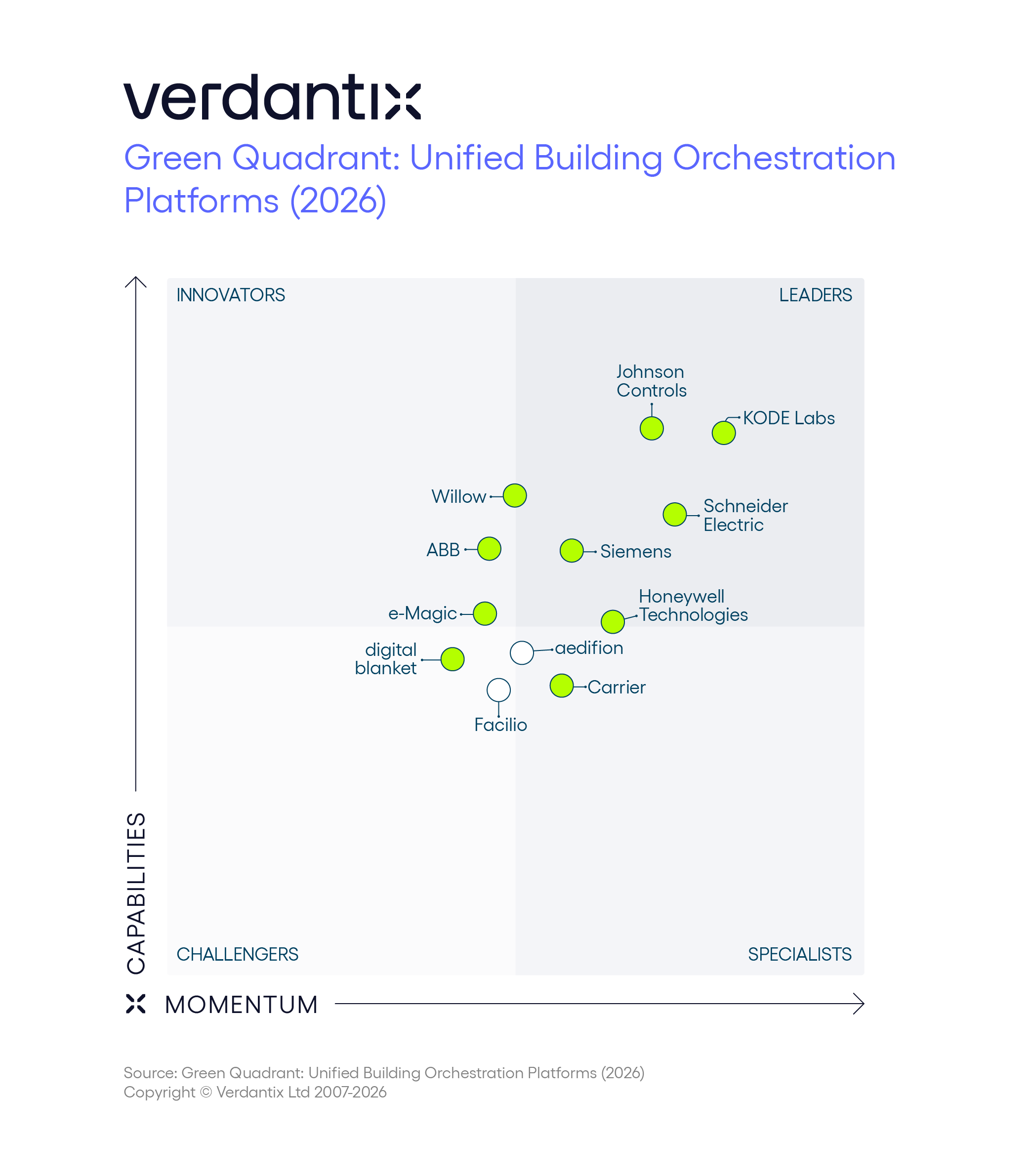
To assess the state of the market and identify the capabilities setting the pace for this emerging category, Verdantix evaluated 12 leading UBOP vendors. The baseline is already significant: every platform assessed can connect to systems from multiple manufacturers, send commands back to those systems and use analytics to identify operational issues. The key differences now lie in what vendors can do beyond these core capabilities – and how far they are taking building software from monitoring and recommendation towards autonomous action.
Coordination: from following rules to resolving conflicts
Most UBOPs can already coordinate systems using predefined rules – for example, switching off the lights and turning down the heating when a meeting room booking ends. The harder challenge arises when goals conflict. Reducing ventilation to save energy may push indoor air quality below target, or an automated command may override an occupant who has just adjusted the temperature. Leading vendors demonstrated platforms that resolve these conflicts, but mostly within heating and cooling. No vendor has yet shown operators setting priorities such as comfort, cost and carbon, or a platform that balances them across every building system. The first to do so will define what ‘unified’ truly means.
AI: from advising operators to acting on their behalf
AI is already embedded across thousands of buildings, but primarily in an advisory role: detecting faults, predicting equipment failures, answering operators' questions in plain language and speeding up the onboarding of new buildings. AI that acts independently is limited to a narrower set of tasks, such as optimizing when equipment starts each morning, running central chiller plants and adjusting room temperatures ahead of weather changes. The main barrier to wider adoption is trust rather than technology, as few building owners are yet willing to let AI act unsupervised. Leading vendors are addressing this directly, with platforms that require approval until the AI has built a track record, automatically reverse commands that do not work and explain the reasoning behind each action.
Interoperability: from connecting to any equipment to fully controlling it
Because most buildings contain equipment from several manufacturers, every platform assessed can connect to and command third-party systems. The difference lies in how deep that control goes. On another manufacturer's equipment, most platforms can adjust setpoints and schedules, but cannot see or change the control logic running inside the equipment's controllers – access that manufacturers typically hold only on their own systems. Some platforms also require their own gateway in every building, even where every system is third-party. Our analysis shows that software-only vendors lead on working across manufacturers, while equipment manufacturers excel in deep control of energy and electrical systems. Expect each group to move towards the other's strengths.
What this means for the market
The leading vendors have laid the foundations of the autonomous building. What comes next will be won on three fronts: resolving conflicts across systems, earning the trust for AI to act, and delivering full control on any manufacturer's equipment.
For a deeper analysis of vendors, market trends and evaluation results, read the full report here: Green Quadrant: Unified Building Orchestration Platforms (2026).
About The Author

Cara Haring
Senior Analyst