Industrial Agility Is Impossible Without Connected Data – Here’s Why
The ever-volatile geopolitical and economic landscape continues to challenge industrial firms with rapidly shifting operating risks. To stay competitive, organizations must implement adaptive operating models built on real-time visibility across assets, processes and supply chains. Achieving this requires predictive and prescriptive operations, flexible execution, rolling scenario simulations and AI‑assisted decision flows. None of these capabilities are possible without connected data spanning the entire operational ecosystem.
Siloed data have long constrained industrial transformation efforts. The fragmented nature of OT and enterprise systems creates barriers between where data are generated and where information is needed for planning and optimization. MES, EAM, QMS, scheduling and supply chain tools often operate independently, forcing teams into slow, manual work that undermines agility. Verdantix research shows that only 18% of firms have fully centralized industrial and enterprise data in a cloud platform. Vendors such as ABB are addressing these siloes across engineering and asset systems.
Consider a production line where vibration data from a pump, flow‑rate trends from MES and incoming raw‑material delivery schedules are all connected in a unified data platform. When the pump begins to show signs of bearing failure, the system can correlate this with a drop in throughput and an incoming shipment, prompting a prescriptive recommendation to schedule a short maintenance window before the issue escalates. This prevents unplanned downtime, protects product quality and avoids downstream supply chain disruption. Platforms such as AVEVA CONNECT enable this kind of real-time data integration.
Industrial organizations are therefore investing in unified data management platforms that create a shared operational context across assets, processes and value chains. Cognite is one example of a vendor that is built for this purpose. Without adequate visibility, firms struggle to plan effectively, respond to disruptions or coordinate decisions across functions.
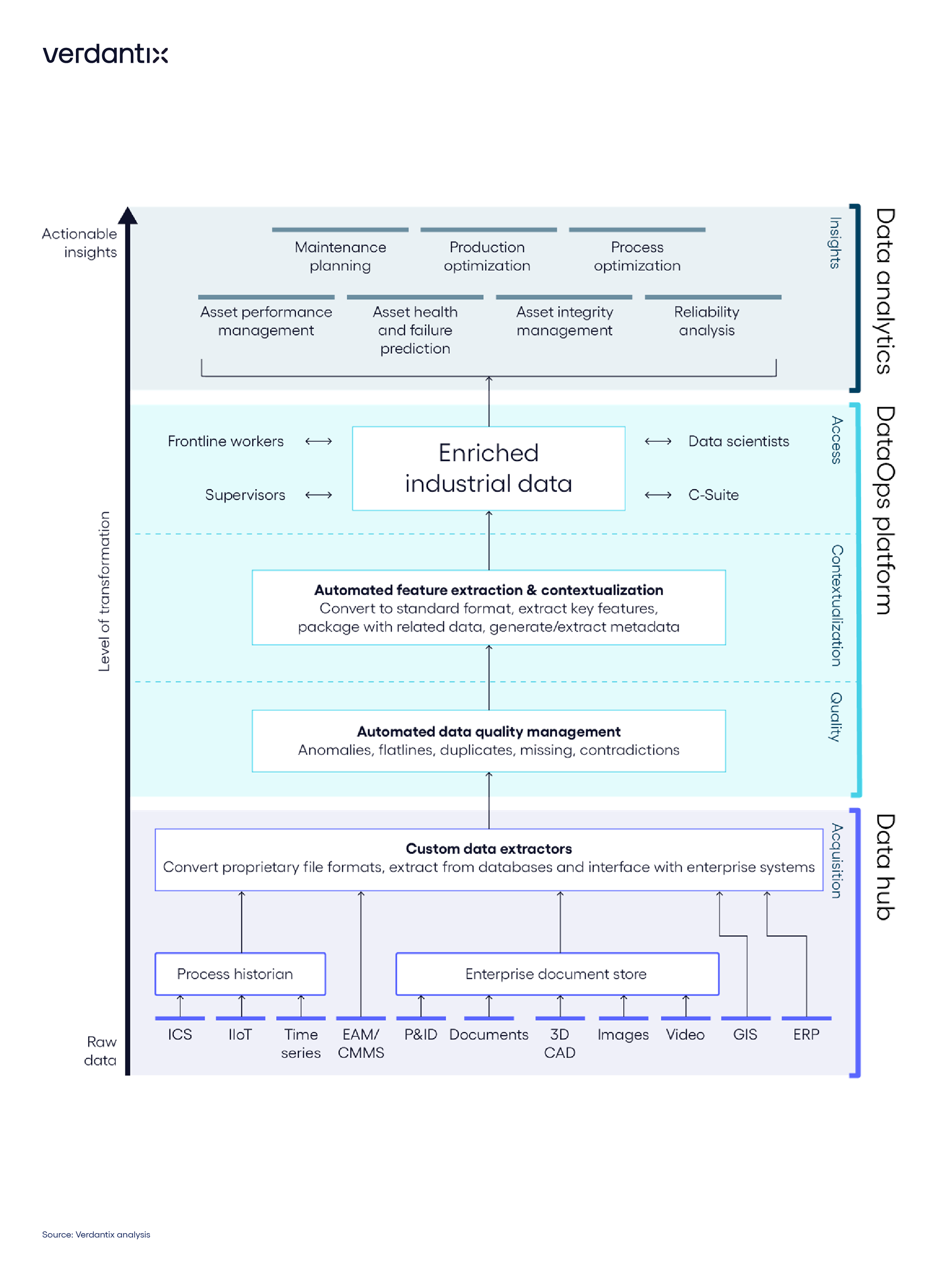
The figure below shows how operational data flows through an organization, from acquisition and quality checks to contextualization, governance and insight generation.
The rise of GenAI copilots and agentic AI further increases the importance of connected data. AI systems require high-quality, contextualized operational data to generate trustworthy insights and automate workflows effectively. Without that foundation, firms risk scaling noise rather than intelligence. C3 AI and SymphonyAI are two examples of vendors embedding AI on top of these data foundations.
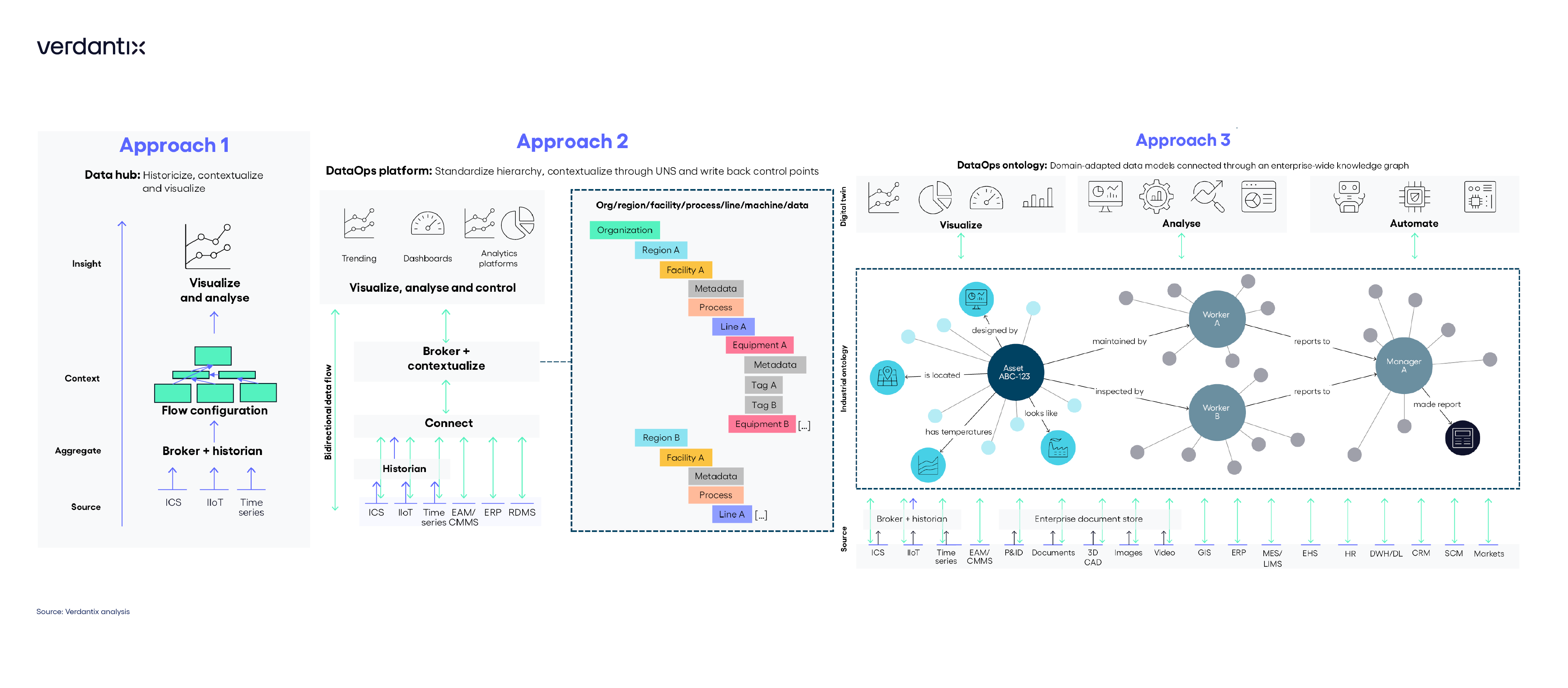
Connected data management is therefore the foundation for transforming a reactive firm into a proactive, insight-driven and operationally agile enterprise. Verdantix identifies three complementary approaches to industrial data management (see below):
- Data hub approach – connects structured OT data such as time series, events and control logs to basic analytics. Typically delivered through process historians and visualization tools, offering local, on-premise data aggregation. Vendors such as Cybus, HighByte and Litmus offer scalable data hub approaches.
- DataOps platform – hybrid edge-to-cloud architectures that curate data through purpose-built software and hardware. These solutions align OT data with business operations through unified namespaces (UNS), hierarchical models and ML-driven analytics.
- DataOps ontology – creates semantic alignment across OT, IT and engineering data to improve interoperability, discoverability and contextual understanding.
Ultimately, a unified data platform brings together fragmented systems to eliminate duplication, strengthen data lineage and enable cross-functional alignment in decision-making. With connected data, organizations gain a clearer, holistic view of operations, allowing them to balance risk, cost and performance more effectively.
This foundation unlocks industrial agility: the ability to detect disruption early, understand its implications, and respond with speed and precision. It equips businesses with continuous asset health intelligence to anticipate failures, real-time production visibility to address bottlenecks, supply transparency to identify risks before they escalate, and robust energy and emissions monitoring to support both cost efficiency and regulatory compliance, positioning teams to operate with confidence in an increasingly complex industrial landscape.
To find out more about industrial agility, check out the Verdantix Dislocation Index.
About The Author

Jatinder Devgun
Senior Analyst